Monday, April 07, 2008

Blog Release: Mega-Regional Pittsburgh

From GLUE:

You’re invited to GLUE’S FIRST-EVER, once monthly,

Sticky Cities Round Up

WHAT? The Great Lakes Urban Exchange wants your input on a mega-regional conversation. What’s good, bad, and ugly about our post-industrial cities? How can we make progress as collaborators rather than competitors? Join us for a 90 minute session occurring simultaneously in 15 cities across the “rustbelt.” See “What is GLUE?” for more information.

TOPIC I : WHAT’S YOUR LAUNDRY LIST? What is holding your city back right now? What issues must most urgently be addressed to help your city get healthy? In your wildest dreams, what could we all do TOGETHER to make change a reality?

WHEN? April 10th 7 PM EST (6 PM CST) – 8:30 EST

WHERE? PGH: THE UNION PROJECT, 801 N. Negley Avenue, 15206

WHO? You and everyone who loves GLUE cities: Akron, Buffalo, Chicago, Cincinnati, Cleveland, Columbus, Des Moines, Detroit, Duluth, Erie, Flint, Fort Wayne, Indianapolis, Lansing, Louisville, Milwaukee, Minneapolis-St. Paul, Pittsburgh, Rochester, St. Louis, Toledo, Youngstown

*** Sticky Cities Round-Ups will begin PROMPTLY at 7 PM EST, 6 CST. Their success will rely on participants’ ability to stick to a regionally coordinated schedule. Chat with us at the tail end of the evening!

*** Diversity of thought, neighborhood, and background are strongly encouraged.

Sponsored by GLUE and the Union Project

Blog Release: Future of our Entrepreneurial Community

From Help Startups:

"Where do we go from here?"
A forum on the future of our entrepreneurial community

Help Startups is pleased to present a major event for all those interested in advancing entrepreneurial activities in the Pittsburgh region. For the first time, top executives of our five major entrepreneurial support organizations will participate in a panel discussion around the theme, "Where Do We Go From Here?" The event will be held on Tuesday, May 6th, from 5:30 - 7:30 pm, at the Rivers Club, One Oxford Centre, 301 Grant Street.

Help Startups is honored to present the following panel participants:

  • Audrey Russo, President & CEO, Pittsburgh Technology Council
  • Matt Harbaugh, Chief Investment Officer, Innovation Works
  • Jim Jordan, Chief Investment Officer, Pittsburgh Life Sciences Greenhouse
  • Mark Borger, VP Business Development, The Technology Collaborative
  • Eddie Yongo, Investment Manager, Idea Foundry

The panel discussion will be moderated by Gary Rosensteel, Executive Director of Help Startups, who stated, "This will be one of the most important events of our entrepreneurial community. This is the first time executives of all these key entrepreneurial organizations have been together on a panel. Also, this is the first time area entrepreneurs will have the opportunity to directly participate in discussions on how we can continue to improve our entrepreneurial environment."

The panelists will start by explaining the role of their organization in our entrepreneurial community, and give us a glimpse of how they see their organizations moving into the future. The discussion will then be opened to the floor for questions around the evening's topic, "Where do we go from here?"

Also, the panelists' organizations, along with other entrepreneurial organizations, will have tables staffed to provide information to Forum participants during the social period preceding the panel discussion. This will afford entrepreneurs and prospective entrepreneurs the opportunity to meet in-person with representatives of all these important organizations.

Registration is required

Please let your colleagues know about this important event!

Tuesday, May 6th, 5:30 pm, Rivers Club

November 28th is Burgh Diaspora Day

On the heels of Carl Kurlander's announcement of a West Coast Pittsburgher gathering, start making your plans to boomerang back home this next Thanksgiving for an extended holiday:

We look forward to showing the movie in Pittsburgh on November 28th at the Byham as part of Pittsburgh's 250, for which we would are inviting all the talent which has left Pittsburgh, including the hundreds who sang "Won't You Be My Neighbor?" In Times Square and Beverly Hills, to come home and reconnect with the city. As Franco Harris says in the movie, "talent, come on back to Pittsburgh!"

Appropriately, tag line for the movie, which is really a comeback story in every sense, is "it's never too late to come back."
I hope that there will be a celebration in more places than just Pittsburgh.

Blog Release: IntoPittsburgh Diaspora Gathering

From Carl Kurlander:

Contact:
Jodi S. Klebick, 412-622-1325, jodi@steeltown.org

“Wine Country” to Become “Mr. Roger’s Neighborhood”

Pittsburghers from West Coast “Neighborhoods” Invited to Reunite in Sonoma

Pittsburgh, PA – April 6, 2008– Pittsburghers from West Coast “Neighborhoods” and neighbors everywhere are being invited to reunite in Sonoma, California to mark the premiere of the locally produced documentary film, “My Tale of Two Cities” at the Sonoma Valley Film Festival on April 11 and 12, 2008 at 3 p.m. at the House of Docs. Steeltown Entertainment Project, in cooperation with 1905 Productions and Pittsburgh 250, is encouraging current and former Pittsburghers, and anyone who feels a part of “The Neighborhood” to join them for a special reunion in the sunny state of California to celebrate Pittsburgh and all things wonderful from “Mister Rogers’ Neighborhood.”

“My Tale of Two Cities” is “the ultimate comeback story of Pittsburgh,” a once great industrial giant that built America with its steel, cured polio, and invented everything from aluminum to the Big Mac, but which now, like a lot of American cities, that is being challenged to reinvent itself for a new age. It also tells the often funny, sometimes moving story of "St. Elmo’s Fire" screenwriter Carl Kurlander, who came home only to find both himself and his beloved hometown in mid-life crisis. (See www.mytaleoftwocities.com for clips and details.) The film is making its debut at the Sonoma Valley Film Festival (April 10-13, 2008), which will also feature a tribute to Pittsburgh native, actor and director Michael Keaton who got his start as a Flying Zucchini Brother on “Mister Rogers’ Neighborhood.”

About the Party.

Anyone who has ever watched the yellow terrible towels fly at Steelers games is familiar with the “Steeler Nation”—which is made up not only of Pittsburgh’s loyal fan, but its large expatriate population, many of whom left home with the decline of the steel industry. With Pittsburgh celebrating its 250th anniversary, and the theme of the film as “It’s Never Too Late to Come Back,” organizers decided the event was a good opportunity to host a Pittsburgh Reunion Party—outside of Pittsburgh—as the town as anyone who has . Therefore, immediately after the 3:00 PM festival screening of “My Tale of Two Cities” on Friday, April 11th, anyone with Pittsburgh roots or who just feels a part of “The Neighborhood” is encouraged to attend a casual gathering of Pittsburghers at Steiner’s Tavern on Sonoma Plaza (RSVP recommended) from 5:00 PM to 8:00 PM. The reunion party will be importing and featuring a variety of Pittsburgh “delicacies” for the homesick and nostalgic, including Iron City Beer, Islay’s Chipped Ham, Jenny Lee Bakery rolls, Heinz condiments, Betsy Ann Chocolates, gourmet popcorn from Popcorn-N-That, and of course, Pittsburgh memorabilia including Terrible Towels.

About the Film

In this election year when many are talking about how America will reinvent itself for a new age, My Tale of Two Cities, a small, but heartfelt documentary about a once great industrial city trying to reinvent itself may strike a chord with many in this country. The film, is talking about Pittsburgh, which everyone knows was once the home of the Steel industry, but may not realize was also the home of the real life “Mister Rogers’ Neighborhood.” On his program, Fred Rogers would often be visited by his mailman Mr. McFeely (David Newell) who would bring him short films of things that were made in the neighborhood. But many of those things are no longer made here and this film asks the question: “What can we as a country make now?”

The film also tells the often funny, and sometimes moving story of St. Elmo’s Fire screenwriter Carl Kurlander, who left Hollywood and moved back to his hometown to teach at the University of Pittsburgh and thought that he and his wife had found the perfect place to raise their daughter. But soon after appearing on “Oprah” to discuss his surprising move, Carl discovered that Pittsburgh, which was one of the richest cities in the world when it was the “Silicon Valley of the Industrial Revolution” a hundred years ago, was now on the verge of bankruptcy. In attempt to help his hometown, Carl does perhaps what Mister Rogers would have done, and goes and asks his neighbors whether the place that historian David McCullough cites as having invented everything from Heinz ketchup to the first movie theater, can once again come back and become “the city of Champions?”

In a tone reminiscent of “Curb Your Enthusiasm”, Kurlander’s friends and neighbors seem to be both helping him and giving him grief at the same time. When Carl tells comedian Louie Anderson he is making a “Mister Rogers & Me” as opposed to a “Roger & Me”, Louie looks straight at the camera and busts his friend: “how long have you been %&$&* waiting to use that line?!” Having grown up a “klutz” in a sports town, Kurlander visits his old gym teacher who is still making fun of him for not being able to catch a football, but then is surprising honest about Pittsburgh’s fear of change and desire to hold on to its once glorious past. Kurlander questions whether his hometown is too obsessed with the Steelers winning for their own good, but is refuted by Steeler legend Franco Harris and his son Dok who articulately remind Carl that it will not be casting blame, but everyone pulling together, that will save their city.

“Mister Rogers Neighborhood” in real life is filled with remarkable neighbors from former Treasury Secretary Paul O’ Neill who has breakfast with Carl at the diner he ate at each morning at 5:30 when he was the CEO of Alcoa; to MacArthur Genius Bill Strickland who has transformed the lives of inner city residents in his own neighborhood with the Manchester Craftsmen’s Guild Arts Center (which has been replicated in San Francisco in the form of BAYCAT); and Teresa Heinz Kerry who goes cheese shopping with Carl in a very funny scene where she orders more cheese than he bargained for, but then ends up talking to him about what well may be the heart of this movie—the need for Pittsburgh—and America—to start dreaming again. Kurlander even visits a nun, Sister Linda Yankoski, and asks her if Pittsburgh needs saving—to which she replies, if people are still holding on to the idea that the steel mills will come back, then maybe it does need “salvation” which she defines as having the faith to let go of the past and take a risk on the future.

The film is surprisingly uplifting as it manages to document moments of Pittsburgh’s rebirth such as Google opening a Pittsburgh office, the dedication of the Dr. Thomas Starzl Biomedical Tower, and Dok winning an “entrepreneur of the year award” in a national competition. It is Franco who echoes the plea of the movie, imploring for the camera: “Talent, come on back to Pittsburgh.” The film ends with a remarkably joyfully celebration of hope as Pittsburghers from Times Square to Beverly Hills, sing Mr. Rogers’ theme song, “Won’t You Be My Neighbor?” which could well be the theme song for this city. As Kurlander and his wife and daughter join hundreds of their neighbors singing this down at The Point, it becomes apparent, that dream of Pittsburgh’s come back as a city is still alive.
---
About Steeltown Entertainment Project: The mission of the Steeltown Entertainment Project ("Steeltown") is to nurture promising talent and to incubate meaningful and commercially viable entertainment projects in Southwestern Pennsylvania by connecting former Pittsburghers who are working in the entertainment industry with the region's human, cultural, educational and economic resources. Steeltown is a registered Pennsylvania 501c3 nonprofit organization. For more information: 412-622-1325 or www.steeltown.org
###

RSVP AND TICKETING INFORMATION FOR THE PITTSBURGH REUNION PARTY & SONOMA VALLEY FILM FESTIVAL FOLLOWS ON PAGE 3.

Steeltown Entertainment Project, in cooperation with 1905 Productions Pittsburgh 250 invite you to come to the sunny state of CALIFORNIA to celebrate Pittsburgh and all things wonderful from “Mister Rogers’ Neighborhood!”

WHEN:

FRIDAY, APRIL 11, 2008
(Second screening, Saturday April 12, 2008)

WHERE:

MOVIE SCREENING: 3:00 PM
Sonoma Valley Film Festival
House of Docs
589 First Street West
Sonoma, CA 95476
http://www.sonomafilmfest.org/

PITTSBURGH REUNION PARTY: 5:00 PM - 8:00 PM

Steiner’s Tavern
465 1st Street West (On the Sonoma Plaza)
Sonoma, CA 95476-6600
RSVP for the PITTSBURGH REUNION PARTY:
Cait Murray, 412-622-1325, mytaleoftwocities@gmail.com

MOVIE TICKETS for “MY TALE OF TWO CITIES:”

We have a limited number of reserved $10 screening tickets which are available out on a “first come, first served” basis to the Friday, April 11, 2008, 3:00 PM screening of “My Tale of Two Cities.” A second screening will also be held on Saturday, April 12, 2008, at 3:00 PM. Contact: Cait Murray at 412-622-1325 or email mytaleoftwocities@gmail.com. Note: Individual movie tickets are also available on a “first come, first served” basis on site at the box office door.

FESTIVAL TICKETS/MICHAEL KEATON TRIBUTE:

For information on passes to the 2008 Sonoma Valley Film Festival, which includes a tribute to Pittsburgh’s own Michael Keaton, please go to www.sonomafilmfest.org

Pittsburgh's Diplomatic Corps

From the Burgh Diaspora in Washington, DC:

If you search diligently in Western Pennsylvania, you might find a steel plant, and a more exacting search might even turn up a steelworker or two, but the industry is long gone from Pittsburgh, replaced by medical complexes and higher education. The bars of the South Side, I am proud to report, made the transition almost seamlessly, and the last time I went drinking there it was with a hospital administrator and some law students.

Still, the outsiders seem to find the place irresistibly exotic. Wrote a New York Times reporter, "Question to our Keystone State readers: What is it with this Pennsylvania fetish for bizarre world food combinations? In Johnstown, this New Yorker encountered the artery-clogging prospect of cheese fries."

Cheese fries? I'm thinking he was either overcome by the sheer foreignness of Johnstown, a city that puts the grit in gritty, or else he was the victim of an overly sheltered childhood. Cheese fries are readily available all over Manhattan, although perhaps not at the kinds of places where he dines.

Maybe Pennsylvania is as strange as the national press thinks and growing up there you just don't notice it. I was back in Pittsburgh for a convention of mainly out-of-staters and the hotel served what it called a Pittsburgh buffet: city chicken (breaded veal on a stick), kielbasa, stuffed cabbage, pierogi. The guests seemed to find this novel and unusual fare. I thought, "I'm back in my high-school cafeteria."

Ask permission before photographing the natives.

No Burger Too Big, Too Dear

Keeping track of Burgh Boomerang tales, a prodigal son is soon to return as "Burger King":

“As my career comes to a close, I’m happy to say that this is one of the best accomplishments of my life,” [Geoff Dobson] told his dining companions Saturday at the restaurant in Destin. The 29-year-old Air Force lieutenant was sitting in front of the restaurant’s Grand Burger, a $100 custom-ground filet mignon served with caviar, beefsteak tomatoes and a grand magnum of imported champagne.

“He needs goals in life,” quipped his friend, Tom Grant.

Dobson was at the pub for his going-away party as well as his and another friend’s promotion. Soon, Dobson will head back to his hometown of Pittsburgh to work as a software developer. He’ll also serve in the Army Active Reserves and expects to deploy to the Middle East in about six months.

GLUE Toledo

Another article on the Great Lakes Union adds a few words about a GLUE meeting this coming Thursday in Toledo:

Patrick Clark, a neighborhood development consultant in Pittsburgh who has worked with Mr. Austin for several projects, said he connects with young people.

“Many of these Chambers of Commerce are clueless in getting paths to these young leaders. John got in front of a group of young leaders and threw some stuff out there and kind of challenged them to take a leadership role and some of them stepped up,” Mr. Clark said.

Two of the young people he offered a hand to are Abby Wilson, 28, of metro Pittsburgh, and Sarah Szurpicki, 27, of metro Detroit, co-founders of the Great Lakes Urban Exchange (GLUE). GLUE has a Website that serves as a video and audio forum about the Great Lakes region, www.gluespace.org.

A GLUE meeting is set for 7 p.m. Thursday at Manhattan’s Restaurant downtown and is open to the public.

Sunday, April 06, 2008

Globalization and Labor Mobility

Minnesota Public Radio recently broadcast Vivek Wadhwa's talk at the City Club of Cleveland, provoking two blogger responses (here and here).

More than ever, I'm determined to make globalization the topic of discussion at the upcoming Rust Belt Bloggers Summit in Erie.

Saturday, April 05, 2008

H-1B Labor Economics

I've begun tracking the media trajectory of Vivek Wadhwa, who has established himself as one of the leading authorities on globalization. Mr. Wadhwa does not shy away from polemics and the IT industry's cry for more talent is no exception:

“It seems like every three years you've got one group or another saying, the world is going to come to an end there is going to be a shortage and so on,” said Vivek Wadhwa, a professor for Duke University’s Master of Engineering Management Program and a former technology CEO himself. “This whole concept of shortages is bogus, it shows a lack of understanding of the labor pool in the USA.”

As a skeptic about the shouts that their isn't a shortage, I found the article compelling, particularly Mr. Wadhwa's solution to any short-term lack of talent:

“If the demand was really there, if these critical shortages that Gartner is forecasting started to happen, guess what? Businesses would start sending some of their experienced users to technology school and a few months later they'd become technology experts who understand the business very well,” Wadhwa said. “So it’s a very shallow, very biased perspective that they've presented and I’m surprised that Gartner put something like this because there is a very deep pool of experienced talent out there which can be trained and which can understand the business side of IT.”

The H-1B visa is helping big tech companies to keep salaries lower. If anything, there is a labor surplus and that's the reason IT wages aren't growing. You want more IT workers Pittsburgh? Offer more money for those jobs. However, most small companies do not enjoy the kind of revenue margins that would allow for a big bump in pay that would attract new students to the field. Wadhwa offers a way around that. Take someone with an advanced degree, say geography. Train that person to write the code you need or whatever else you might require. That's what the GIS industry did.

In 2005, an MBA from the following academic programs would earn you right of entry to the UK:

* Harvard Business School (USA)
* Columbia Business School (USA)
* University of Pennsylvania: Wharton (USA)
* IMD (SWI)
* University of Chicago (USA)
* Dartmouth College: Tuck (USA)
* Stanford University (USA)
* Insead (FR/Sing)
* University of Oxford: Said (UK)
* MIT: Sloan (USA)
* Ashridge (UK)
* North Western: Kellogg (USA)
* London Business School (UK)
* New York University: Stern (US)
* University of Strathclyde (UK)
* IESE Business School (SP)
* Yale School of Management (USA)
* Warwick Business School (UK)
* City University: Cass (UK)
* Rotterdam School of Management (Neth)
* UC Berkeley: Haas (USA)
* University of Cambridge: Judge (UK)
* Georgetown University: McDonough (USA)
* Instituto de Empresa (SP)
* Cornell University: Johnson (USA)
* University of Michigan (USA)
* Duke University: Fuqua (USA)
* University of Virginia: Darden (USA)
* Carnegie Mellon University (USA)
* SDA Bocconi (IT)
* Emory University: Goizueta (USA)
* UCLA: Anderson (USA)
* Manchester Business School (UK)
* Cranfield School of Management (UK)
* University of Toronto: Rotman (CAN)
* University College Dublin: Smurfit (IRE)
* University of Southern California: Marshall (USA)
* University of Rochester: Simon (USA)
* Vanderbilt University: Owen (USA)
* Rice University: Jones (USA)
* University of North Carolina: Kenan-Flagler (USA)
* Babson College: Olin (USA)
* Melbourne Business School (AUS)
* Ceibs (CHN)
* Australian Graduate School of Management (AUS)
* Universiteit Nyenrode (NTH)
* University of Western Ontario: Ivey (CAN)
* Boston University School of Management (USA)
* University of Maryland: Smith (USA)
* Bradford School of Management/Nimbas (UK/NTH/GER)


If you need a certain kind of talent, then the UK demonstrates how to go about it. The H-1B visa is a sham.

Great Lakes Globalization 101

WNYC interviews John Austin, Mr. GLEI himself. You can find the podcast here. Austin provides a broadly accessible overview of the issues (problems and opportunities) of globalization facing the Great Lakes mega-region. Mr. Austin's message is well practiced and sound-byte ready. How does all this information trickle down to the workers, residents and voters?

Friday, April 04, 2008

Toronto Heart Richard Florida?

Eye Weekly takes another shot at the Richard Florida Revolution:

But it was during his time at George Mason University where his theories of a Creative Class took shape — after establishing his academic career at Carnegie Mellon in Pittsburgh — becoming the stuff of best-selling books, an institute, and lucrative speaking gigs. “I thought that if I moved to Washington that maybe I could change the United States,” Florida demurs. And, when that wasn’t quite happening, he made a little spreadsheet — not on a computer, but napkin scribbles, he clarifies — to help pinpoint the precise place where he needed to be.

Oh, combined with the fact that Rotman School dean Roger Martin offered him an opportunity to run the $120 million Prosperity Institute from a Toronto base. (And, for what amounts to a tertiary part-time job as a professor, he earns $169,999.98 a year according to this week’s Public Sector Salary Disclosure.)

If the Dr. Florida migration doesn't demonstrate the value of geographic mobility, then I don't know what does.

Rust Belt Innovation Zone

Since my return from the beach, I've been searching for a launching point to jump back into latest round of energy pulsing through the Great Lakes Economic Initiative. The Toronto Star serves up the blog fodder, fleshing out John Austin's machinations:

For one thing, the Canadian government helped finance the research. The Brookings Institution's original intent was to draft an economic blueprint for America's "rust belt" but after its early findings were released, Ottawa asked for a supplement incorporating Canadian data.

A second problem is that there is very little appetite in Washington for trade liberalization right now. American voters want – and their legislators are offering – protection from low-cost foreign competition.

Finally, there is the issue of money. Austin's proposals would require a substantial commitment of public funds at a time when neither government is in a mood to invest.

The GLUE project aside, Brookings is proposing a top-down solution to the challenges of globalization for the Postindustrial Heartland. I'm reminded of Vivek Wadhwa's critique of China's approach to grabbing market share in the knowledge economy. Government engineering is a poor solution. Instead of trying to change the political geography, let's figure out a way to take advantage of it.

Globalizationburgh

While on my blog sabbatical, I received a few e-mail messages from immigration lawyer Richard Herman. I already commented on the InformationWeek article that mentions the Rust Belt high-skill immigration zone policy. I wouldn't bother reading the responses (more of the same hyperbole you can find just about anywhere) to the IW H-1B visa update. An op-ed in the Wall Street Journal advocates for H-1B liberalization and doing away with the cap. That's a tough sell and unlikely to happen. The same stories are recycled each year as we approach the H-1B lottery and no substantive reforms are enacted.

The freshest perspective on the "talent shortage" problem comes from Vivek Wadhwa, who recently participated in a webcast courtesy of the South Asian Journalists Association (SAJA) and Sree Sreenivasan. If you listened to the podcast of Wadhwa's visit to Cleveland, you needn't take the hour to hear what he had to say to Mr. Sreenivasan. Nonetheless, I will summarize his main argument and touch on a few of his policy suggestions that I think Pittsburgh should seriously consider.

Mr. Wadhwa would scrap the H-1B visa program, opting instead for expedited green cards for the most promising entrepreneurs. The focus is on job creation, not the demand for engineers and scientists. Furthermore, Wadhwa eschews the top-down approach to innovation, particularly found in China. The bottom-up foment of ideas is America's comparative advantage and if native students should be studying anything, Mr. Wadhwa suggests geography.

That last point is Wadhwa's tongue-and-cheek way of saying that Americans need to understand globalization better, which is the same message that Richard Longworth is evangelizing. What resonated with me is Wadhwa's instruction that the United States should now learn from India as it once did from Japan. Microsoft might be starved for talent, but Indian high-tech companies have a much tougher go of it. The ability of Indian entrepreneurs to work around the political and cultural barriers is impressive. The lesson is that a government-led initiative, such as attracting more students to the fields of science and engineering, is not the answer.

Concerning Pittsburgh, looking to India for different approach would seem to be a natural fit. In the latest Pittsburgh Quarterly, Dennis Unkovic maps Pittsburgh geopolitics. The economic bet is between India and China. Mr. Unkovic chooses India as Pittsburgh's best partner. What is good for India is good for Pittsburgh:

India’s growth may end up helping some cities and regions. Pittsburgh has lots of connections with India because so many Indians have attended college or graduate school there. Because the emerging industries in Pittsburgh are the very ones gaining traction in India (technology- and knowledge-based services, biotechnology, medicine and software development) Pittsburgh may ride India’s coattails to growth.

As for China, Unkovic considers its relationship with Pittsburgh to be a wash. As Pittsburgh begins to grapple with how to best manage its human capital assets, the region best heed what Mr. Unkovic and Mr. Wadwha have to say about taking a closer look at India.

Wednesday, April 02, 2008

H-1B Visa Reform Gaining Steam

While in Charleston, SC visiting my kin, I've neglected my blogging. The world kept turning while I entertained Postindustrial Heartland dreams on Folly Beach. Richard Herman passed along a few items that I'll address in a later post, but I wanted first to cover a more recent article about the H-1B visa controversy:

"There'll be a flood" of H-1B visa petitions submitted, predicted Angelo Paparelli, president of the Alliance of Business Immigration Lawyers and managing partner of Paparelli & Partners, a law practice with offices in New York and California.

The five-day window gives more time for smaller companies "that need just one or two" foreign professionals to "get their ducks in order," Paparelli said. However, the large volume of petitions expected to arrive at USCIS doesn't help those companies' chances of having their applications picked in the random lottery.

That's why Paparelli, who supports the H-1B visa cap being raised, has something in common with opponents of the H-1B visa program. Paparelli and others want to see the H-1B visa lottery dumped in favor of a more "logical system." Among the alternatives to the lottery system being suggested is evaluating the merit of the employer's request, evaluating the qualifications of the individual, or showing a documented shortage of skills in various geographic regions of the United States.

The Greater Cleveland Partnership (Cleveland's Chamber of Commerce) is proposing changes to the H-1B visa system to create "high-skill immigration zones" in the Midwest and "Rust Belt" cities.

Kim Berry, president of U.S. IT worker advocacy group Programmers Guild, says he's looking for several H-1B visa reforms, including "replacing the random lottery with competitive system where employers compete based on salary -- a reasonable proxy for skill -- just as they must do for the top candidates among U.S. workers."

While I'm happy to see that Mr. Herman's policy innovation is receiving more press, I wish the growing Great Lakes collaborative would throw their weight behind the lobbying effort. I know that Mr. Herman reached out to Richard Longworth and Jim Marczak. However, I'm not sure how a not-so-humble blogger living in Colorado can further catalyze substantive action.

Meanwhile, John Austin, GLEI and GLUE continue to move forward with their vision. I figure I need to make some progress with my own. Over at Rust Belt Bloggers, we are toying with the idea of taking up Mr. Longworth's proposition for better regional coverage of globalization. I'm interested in finding other bloggers who help me take up this challenge. We could further discuss this issue at the Rust Belt Bloggers Summit in Erie this July (11th-12th), but I recommend a few blog exchanges on the subject sooner rather than later.

Blog Release: Picture Perfect Pittsburgh

Mark Bolster, a fellow Burgh-centric blogger, sent to me an e-mail message about his new book: "Pittsburgh: A Photographic Portrait." I am glad to support his endeavor with a plug, but I also figure members of the Burgh Diaspora would appreciate a new round of pictures of their favorite city.

Blog Release: Innovative Pittsburgh

From Project Olympus:

Dear Friends,

I am pleased to invite you to Project Olympus Show and Tell 5: Wednesday, April 23, 3:30-5pm in the 1st floor Lecture Hall of the Collaborative Innovation Center at Carnegie Mellon.

A reception will follow at Apple Pittsburgh (upstairs) and I hope you will be able to attend.

Registration is advised and requested, please see:
http://www.olympus.cs.cmu.edu/events/

We have another fun and stimulating program in store, chock full of exciting talent and ideas, showcasing university research, budding talent and new community initiatives:

Highlighting research from the School of Computer Science (SCS) and the Department of Electrical and Computer Engineering (ECE):

-Prof. Mor Harchol-Balter, CS, "Power Management in Server Farms"
-Prof. Nancy Pollard, CS and Robotics, "Shaking Hands with Robots"
-Prof. Priya Narasimhan, ECE and ISR, "Assistive Mobile Technologies for the Blind"

Outreach:
-Carol Frieze, Director, Women@SCS
"Diversifying the Images of Computing: The Outreach Roadshow"

CONNECTing with the region:
-Audrey Russo, President & CEO, Pittsburgh Technology Council,
"The New Pittsburgh"

The Show and Tell poster can be downloaded from:
http://www.olympus.cs.cmu.edu/events/ST_April23/ShowTell5_poster.pdf

Tuesday, March 25, 2008

Great Lakes Union

I gather that the main media splash for the Brookings report hit today:

Ottawa
Toronto
Youngstown

I also figure I missed a bunch of stories that filtered out this past weekend:

Buffalo
Associated Press

Pittsburgh's Jim Marczak might be party to the bi-national initiative to reduce the border drag on the mega-regional economy, which would explain the EriO and GLEI references.

Monday, March 24, 2008

Great Lakes Globalization

Rust Belt Blogger Ed Morrison catches the only (that I've seen thus far) coverage of the latest Great Lakes initiative from our friends at Brookings. For whatever reason, ideas for a better future of the Postindustrial Heartland seems to get more play in Canada. The article appears in the Windsor Star. The Canadian newspaper cites one particular passage from the Brookings report that drew my attention:

States, provinces, and localities all have parochial and unconnected economic development plans to capitalize on their waterfronts. Existing bi-national organizations charged with Great Lakes stewardship are either focused solely on water preservation or too hamstrung by their particular organizational history and politics to focus on regionwide water-based economic development.

The Great Lakes regional identity, which is intended to overcome the silo-mentality that Richard Longworth describes in Caught in the Middle, struggles to find relevance in Rust Belt river cities such as Pittsburgh. Abby Wilson of GLUE tackles this vexing geographic problem in a recent blog post:

I have had several recent conversations with some of Pittsburgh’s self-identified regional taxonomists who disagree with GLUE’s categorization of the burgh as a Great Lakes city. I will be the first to admit we are not dealing with a cut and dry categorization here.

Longworth wouldn't extend his Midwest region to any part of Pennsylvania and as Abby notes, most of Pittsburgh would agree with him. Pittsburgh is a Great Lakes city thanks to one degree of separation, the urban link with Cleveland. Cleveburgh is an easy and obvious connection to draw. The problem is invoking the Great Lakes as the regional touchstone.

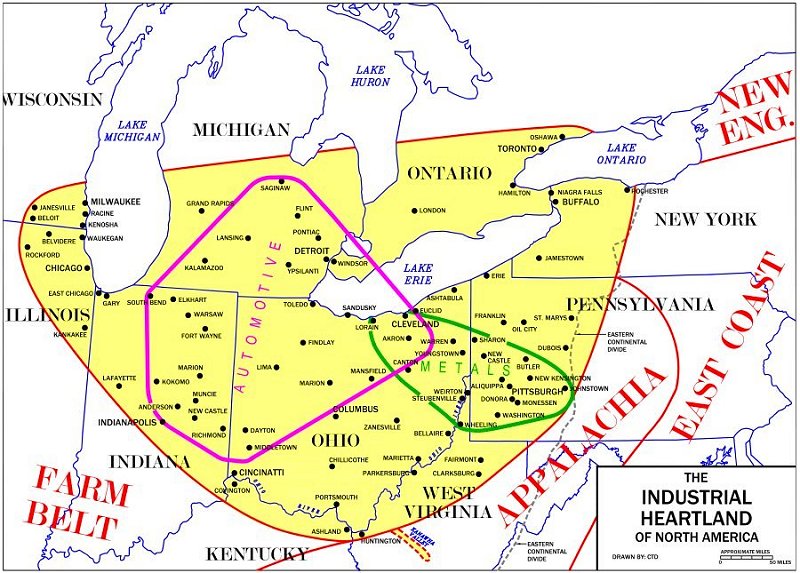
With all due respect to the GLUE region, I've been promoting this map of the Post-Industrial Heartland. I think the associated narrative is instructive:

When studying the coalfields of Appalachia, it is also beneficial to take a look at the area that was one of the biggest destinations for Appalachian coal during the golden age of coal mining: The Industrial Heartland (called by some the Rust Belt). This is a region that centers around the Great Lakes and the Ohio River, both of which supplied the river transporation that gave the area's industries an advantage. The Rust Belt was also once endowed with ample rail transporation. While that may still be true, the steel rails on many lines have been removed. Appalachian coal was transported by these means to the steel mills of Pittsburgh and Chicago, automobile factories in Detroit, electrical power plants, and various manufacturing plants such as the International Harvester or Firestone.

The Industrial Heartland attracted a huge number of immigrants from 1890-1930. The Polish came in droves, especially to Pittsburgh and the Chicago-Milwaukee area. Italians immigrated also, explaining why eight of the 24 Mafia families in America were located in the region. Some other immigrants were Irish, Greek, Slovak, Slovenian, Lituanian, and Hungarian, among others. African-Americans came from the Southern U.S. looking for opportunity as well. All of these people were added to the German and Scots-Irish population that was already present in the area. Echoes of this diversity in the Industrial Heartland today are heard in radio shows and various festivals.

The Postindustrial Heartland shares economic, political and social geographies. There is no need to remake the wheel and construct a new regional identity. The former comparative advantage of proximity to water transport is well documented and Tech Futures Chris Varley re-emphasized this perspective in moving Northeast Ohio forward. If you think of the Great Lakes as the other Ohio River, then the mega-regional connection is quite obvious.

Blog Release: Regional Connectivity

From The Business Journal of Youngstown:

YOUNGSTOWN, Ohio -- The Youngstown/Warren Regional Chamber announced this morning that one of its executives took part in a conference last month that crafted a five-point economic policy agenda for the Great Lakes region.

The policy agenda, released last week, lists priorities to be pursued by chambers representing metropolitan areas in the Great Lakes region. According to Tony Paglia, Regional Chamber vice president of government affairs, the agenda that emerged is based on five priorities for political advocacy. The priorities are:

1. Create federal transportation infrastructure policy and funding that supports the unique needs of inland metropolitan regions that today operate as global gateways and centers of trade and commerce.

2. Construct a 21st century border with Canada that balances national security with economic security through accelerating bi-national economic advantage in the movement of goods and people.

3. Establish federal immigration policy that facilitates international talent attraction, integration and retention driven by the assets and needs of the Great Lakes Region.

4. Build a Great Lakes innovation strategy that fuels research, development and commercialization activity in key industrial sectors.

5. Renew and leverage the Great Lakes by supporting business development and research opportunities compatible with fresh water technology and water-based development, while protecting and improving both the supply and the quality of water. Complete the proposed Great Lakes Restoration plan pending before Congress.

Summit participants worked on the Great Lakes agenda based on analysis of the Midwest economy by the Brookings Institution Metropolitan Policy Program, Paglia said.

A follow-up summit will take place later this year with members of Congress representing the Great Lakes region, he added.

Blog Release:Innovative Pittsburgh

From Project Olympus:

Project Olympus will be holding our 4th Show and Tell,
Wednesday, March 26, 3:30-5pm
in the 1st floor Lecture Hall of the
Collaborative Innovation Center at Carnegie Mellon.
A reception will follow at the Intel Lab upstairs.
I hope you will be able to attend.

Registration is advised and requested, please see:
http://www.olympus.cs.cmu.edu/events/

Program Highlights:

A FOCUS ON RESEARCH from the School of Computer Science:
-Prof. Seth Goldstein (Claytronics Project), "The Future is Programmable"
-Prof. Carlos Guestrin (Select Lab), "Optimizing Sensing: from Water to
the Web"
-Prof. Latanya Sweeney (Data Privacy Lab), "Fast Capture of Fingerprints"

NEW KID ON THE BLOCK:
-Jeff Mullen (DYNAMICS), "Eliminating Credit Card Fraud"

Olympus CONNECTs:
-Matt Harbaugh, Jim Jen (Innovation Works), "Launching the AlphaLab"

The Show and Tell poster can be downloaded from:
http://www.olympus.cs.cmu.edu/events/ST_March2608/ShowTell4.pdf