Monday, February 22, 2016

Donald Trump Testing Sun Belt Exceptionalism

Democrats lost West Virginia to the Republicans. Early in the POTUS primary battles, the Republicans seem to have lost West Virginia to Donald Trump. And by "West Virginia", I mean economically dislocated blue collar white males. This demographic used to be angry at liberals. Now, they are furious with the political party that promised them employment salvation.

The Tea Party first blamed union-friendly liberals for Rust Belt woes. In swept a host of GOP governors who promised austerity and fiscal responsibility. Deregulation would make Made in the USA competitive again because labor, not management, killed the goose that laid the golden egg.

If any state represented Sun Belt in the Rust Belt, Indiana does. Manufacturing still dominates there like no place else. All the polity needed was some middle class common sense ample in the sprawling, booming South. Baseline Indianoplace, "Downtown...was once so desolate that men armed with shotguns hunted pigeons on Sundays among empty buildings and a trash-strewn river canal."

Fair to say, Indianapolis is an exception to the Rust Belt city rule. Perhaps Richard Longworth is right to hold up the Sun Belt playbook for America's Middle West. Not. So. Fast. "Workers 'Devastated' by Carrier's Plan to Move Indianapolis Facility to Mexico":

"It's pretty damn bad when you've got people that figured they'd be able to retire there with some dignity and due to no fault of their own, now they're finding out they're not going to have a job," Chuck Jones, the president of United Steelworkers Local 1999, told RTV6 Tuesday.

Donald Trump gives voice to people like Chuck Jones. Manufacturers and Republicans promised workers some dignity in exchange for their vote. The GOP (and its subsidies) failed, miserably, to deliver. 2016 is the reckoning.

Monday, January 04, 2016

Economic Geography of the Cloud

An abundance of digital data predicts where the jobs will be.

Theme: Economic restructuring

Subject Article: "A Surgery Center That Doubles as an Idea Lab."

Other Links: 1. "Google to Make Driverless Cars an Alphabet Company in 2016."
2. "IBM’s latest deal is a new test case for the big data economy."
3. "'Moneyball' meets medicine: DePodesta joins Topol at Scripps."
4. "Seattle Is the Next Detroit."
5. "Time travel: An isochronic map shows where to go, how long it took to get there – and what changes were on the way."
6. "The next civil rights issue of our time."
7. "Buckaroo Banzai - There You Are."

Postscript: Flipping my post on its head, "The Urban, Infrastructural Geography Of ‘The Cloud’." If you are interested in walking into the cloud, read that. This understanding is backwards. The data a user consumes comes from the cloud, which is located in some physical location that conforms to some rhyme and reason that looks like economic geography. The economic geography I'm describing is a smartphone input. The "user" produces data, which goes into the cloud. That data input is just noise, lots of information with no rhyme or reason until some algorithm finds the signal and transforms all those 1s and 0s into knowledge.

Wednesday, December 16, 2015

Mapping Yesterday's Economic Geography, Today

The economy we measure isn't the economy we have.

Theme: Ironic demography

Subject Article: "Time travel: An isochronic map shows where to go, how long it took to get there – and what changes were on the way."

Other Links: 1. "Commentary: Modernising Economic Statistics: Why It Matters."
2. "Demographic Deception."
3. "American Experience Transcript: Henry Ford."
4. "Seattle Is the Next Detroit."
5. "What GDP can’t tell us: Politicians pay too much attention to this outdated indicator of economic growth."

Postscript: Lurking beneath the surface of my last two posts is the debate about the productivity paradox. Either the best days of innovation are behind us or ahead of us. Regardless, the benefits of new technologies aren't showing up in the productivity statistics. For the techno-optimists, a possible (partial) explanation:

This theory asserts that productivity growth in health care is inherently low for the same reason it is in education: Productivity-enhancing technologies cannot easily replace human doctors or teachers. In contrast with, say, manufacturing — a sector in which machines have rapidly taken over functions that workers used to do, and have done them better and more cheaply — there are, at least for the time being, far fewer machines that can step in and outperform doctors, nurses or other health sector jobs.

To be crude, the growing share of eds/meds employment for the overall labor market may be dragging down the efficacy of technology to boost productivity. What if the world is on the cusp of rapid advances in the productivity and efficiency of health care services? What if, indeed:

My favorite example is electronic medical records (my wife is a doctor), which have tremendous potential to enhance the efficiency of healthcare delivery in the US. Even today, most information on patient care is transmitted between clinics and hospitals, and between generalists and specialists, by fax and telephone. A less efficient system is hard to imagine – other, that is, than attempting to coordinate patient care in the traditional way while undertaking the transition to electronic record keeping. New systems are being adopted and serially abandoned as their deficiencies are discovered. Different medical clinics and hospitals are installing systems that are incompatible and unable to communicate with one another.

Doctors will one day look back on all of this as healthy experimentation. For the moment, however, they are tearing their hair out. They are delivering less patient care as they spend more time hunched over their laptops, inputting data that adds nothing, currently, to their productivity.

Once all health care data is digitized, innovation should come fast and furious.

Monday, December 14, 2015

Seattle Is the Next Detroit

Henry Ford and Detroit radically changed the economic geography of the world. Now, Jeff Bezos and Seattle are poised to do the same.

Theme: Economic geography

Subject Article: "Amazon growing faster than ever — adds record 18,000 workers in quarter to top 183,000 globally."

Other Links: 1. "Beyond Rust: Metropolitan Pittsburgh and the Fate of Industrial America."
2. "The Second Machine Age Is Dying."
3. "Amazon’s unprecedented growth is too risky for Seattle."
4. "Census: Seattle is the fastest-growing big city in the U.S."
5. "Seattle’s population boom approaching Gold Rush numbers."
6. "American Experience Transcript: Henry Ford."
7. "Cities of Knowledge: Cold War Science and the Search for the Next Silicon Valley."
8. "American Experience: Silicon Valley."
9. "‘The Rise and Fall of Urban Economies.’"

Postscript: Amazon will remake economic geography in more ways than just the cloud:

Amazon has been investing heavily in the logistics needed to extend all the way through its delivery chain. It is buying its own truck trailers, hiring on-demand delivery workers and building a new type of delivery hub — with technology that has thus far been kept under wraps — in major cities from Seattle to New York.

Analysts believe door to door delivery could be the next big sector that Amazon disrupts, in the same way it shook up cloud computing services by launching Amazon Web Services.

“The logical next step is, if you are going to have all this infrastructure, why not open it up to be a competitor to logistics networks like FedEx and UPS,” says Scot Wingo, executive chairman of ChannelAdvisor, a software provider for retailers that use Amazon and eBay. “I fully believe it’s something they could go after and be successful at.”

AWS is a much bigger disruption than the reinvention of logistics. In fact, the cloud allows Amazon to take on FedEx and UPS, dominating online retail. For now, I thinking AWS will shape where we work. A new type of delivery hub could shape where we live.

Wednesday, November 18, 2015

Los Angeles Is What New York Wants to Be When It Grows Up

If New York City is your adolescent self, then Los Angeles is what you aspire to.

Theme: Urban hierarchies

Subject Article: "How the Steady Stream of Creative Talent Moving From N.Y. to L.A. Became a Flood."

Other Links: 1. "Ed Soja 1940 - 2015."

Postscript: I'm wondering aloud if Los Angeles or someplace else could supplant New York City as the best talent refinery in the United States (if not the world). NYC could be enjoying the momentum of mesofacts. Or, NYC might be unassailable, as per the rank-size rule. I suspect the latter is true. See NYLON. Regardless, the bigger map is one of life cycles and the expanding scale of geography. Instead of leaving Manhattan for a Connecticut suburb, one migrates to Los Angeles.

Monday, November 16, 2015

Lock-Out From Prosperity

California is a fortress of gentrification.

Theme: Geography of gentrification

Subject Article: "The Lock-in Effect of California's Proposition 13."

Other Links: 1. "The Geography of 'Displacement.'"
2. "When Moving Matters: Residential and Economic Mobility Trends in America, 1880-2010."
3. "For Millennials, Buying an Unaffordable Home Isn’t Always a Bad Idea."
4. "So You’re Moving To Portland."

Postscript: Article is Oregon-centric, but does a nice job of discussing interstate and intra-state migration in disaggregated terms. Using rates, California does a poor job of attracting new residents. However, the state does a "good" job of retaining them. Both trends can thank Prop 13. I'd love to know the percent of in-state movers who are renters.

Friday, November 13, 2015

Sociolinguistics and the Geography of Innovation

The decline of the Southern drawl maps the diffusion of knowledge production in the United States.

Theme: Geography of economic development

Subject Article: "As a Southern community changes, an accent fades: Southern accents are declining in North Carolina. What does that tell us about social dynamics?"

Other Links: 1. "Altered States: A Perspective on 75 Years of State Income Growth."
2. "Debunking Texas Exceptionalism: De-Regulation Will Not Save Us."
3. "Fortresses of Globalization and Wilmington, Delaware."

Postscript: From "Interact with a wider circle and your ideas will take flight":

Decades ago, the University of Chicago sociologist Ron Burt showed that what matters about a social network, whether face-to-face or virtual, is neither its size nor the prominence of its contacts but the extent to which it provides exposure to people and ideas you do not already know.

The diminishing Southern accent is an indicator of a wider circle of ideas, which spurs innovation. Migration, not proximity nor density nor tolerance, foments creativity.

Tuesday, November 10, 2015

Goldilocks and the Geography of Innovation

A sweet spot in the Technology Readiness Level attracts private industry.

Theme: Economic geography of innovation

Subject Article: "Uber Would Like to Buy Your Robotics Department."

Other Links: 1. "Richard Florida, Roger Martin and David Wolfe on getting innovation right."
2. "Cities of Knowledge: Cold War Science and the Search for the Next Silicon Valley."
3. "From Metal to Minds: Economic Restructuring in the Rust Belt."
4. "Boston Versus Silicon Valley: Advantage Beantown."
5. "Toyota Invests $1 Billion in Artificial Intelligence in U.S."
6. "The Valley of Death."

Postscript: In "Engine or Infrastructure? The University Role in Economic Development" (1999), Richard Florida writes:

It is quite clear that Silicon Valley or the Cambridge/Boston regions are not the only places with excellent universities working in areas of potential commercial importance.  One way to begin to structure the problem is to think of the relationship between the university and the economy as composing a simple two-dimensional system, in which the university transmits a signal, which the regional economic environment must absorb.  Increasing the volume of the signal need not result in effective transmission or absorption if the region's transmitters, so to speak, are not turned on or are functioning ineffectively.  In short,the university appears to be a necessary but insufficient condition for regional technological and economic development.  To borrow a phrase from the work of my CMU colleague, Wesley Cohen and Daniel Levinthal (1990) what appears to matter here--and what is to often neglected in policy circles--is what we might call  "regional absorptive capacity,” the ability of a region to absorb the science, innovation, and technologies which universities generate.  Another way of saying this is that regions need to capture the "spillovers" of the technologies and innovations they generate.

I'll start by saying that there is a lot in Florida's paper that resonates with my own research into the matter. Also, the above quoted passage can adequately explain why tech transfer did not flower in Pittsburgh. I've learned that the flowering of tech transfer is rather beside the point. What happens at the university along the NASA scale from Levels 4-7 is, indeed, driving regional economic development.

Thursday, November 05, 2015

How Defining a Metropolitan Statistical Area Promotes Poverty

A metro only exists for those who can afford to commute.

Theme: Geography of poverty

Subject Article: "Mass. economy booms, but the effect is uneven: The town of Acton and the Boston neighborhood of Mattapan are only 30 miles apart, but one is booming while the other languishes in high unemployment and poverty."

Other Links: 1. "About Metropolitan and Micropolitan Statistical Areas."

Postscript: As an amenity young adult urbanists adore, transit is divorced from employment. Considering "transit deserts" in Toronto:

To the authors of a new study out of the City Institute at York University, these facts expose “transit inequity” in Toronto: the people most dependent on transit, who pay a higher portion of their income to ride it, also get the worst service. The report, titled Switching Tracks, suggests ways the Greater Toronto and Hamilton Area can achieve greater “transit justice.”

Among its main contentions is that, historically, major transit projects exacerbate social inequality. “The majority of infrastructure investments in the modern city have privileged the rich,” said Roger Keil, a co-author of the report. This is not only because wealthier citizens tend to wield more political clout, but because conventional planning wisdom dictates that major rapid transit lines should connect areas that are already thriving: dense residential zones, booming commercial areas, and transportation hubs.

Not only do transit projects help concentrate poverty, they are used to attract and retain millennials (e.g. Atlanta). Transit planners bear some responsibility for the growing inequality divide, as seen in the case of Boston. Jobs go unfilled in Acton while the unemployment line in Mattapan grows longer. Instead of tackling this issue, the question asked is "When Are You Getting Late-Night Subway Service?"

Monday, November 02, 2015

Higher Education Is Dying

Wage convergence is hitting many industries, including higher education as well as oil and gas.

Theme: Economic restructuring

Subject Article: "Don’t Be So Sure the Economy Will Return to Normal."

Other Links: 1. "Oil and gas execs say companies still recruiting to keep up with talent lost in layoffs."

Postscript: The oil bust is more about supply than demand. However, don't be so sure the energy economy will return to normal:

The idea that supplies of fossil fuels will grow ever tighter as demand increases, pushing prices inexorably higher, has been put on ice, perhaps forever. The lesson of the past decade is that so long as the right technology, capital and legal frameworks are in place, oil and gas will flow. If the world is to shift away from fossil fuels, therefore, governments will need to take deliberate policy actions to make that happen.

On the heels of a supply revolution (technologically driven by US industry) may come a demand revolution, driven by demographic decline and the second half of the chessboard for the second machine age.

Friday, October 23, 2015

The Geography of 'Displacement'

You keep using that word. I do not think it means what you think it means.

Theme: Migration and economic development

Subject Article: "An Antidote for the Unjust City: Planning to Stay."

Other Links: 1. "Economist Raj Chetty’s Proposals on Inequality Draw Interest on Both Sides of the Political Aisle."

Postscript: From "‘Migrants’ or ‘refugees’? It’s the wrong question. Here’s how to help the people fleeing to Europe.":

Focusing on whether to call the people entering Europe “migrants” or “refugees“ is itself part of the problem. It reinforces the idea that people on the move can be divided neatly into one of two categories: migrant or refugee. Human beings in the real world defy such simplistic categorization. They move for a wide range of reasons that fall somewhere between the extremes of purely voluntary and unquestionably forced.

Even to claim that migrants (or refugees) are "fleeing" is a simplistic categorization. The term "displacement" also deserves the same careful consideration.

Wednesday, October 21, 2015

When Generation Rent Becomes Generation Buy

Regions where Millennials are renting don't look like where they will buy homes.

Theme: Migration and housing

Subject Article: "Quick: Why I bought a house in Carbondale."

Other Links: 1. "Why the D.C. area risks losing its allure to millennials."

Postscript: Instead of fleeing the city for the suburbs, I think young adults looking to raise a family will leave the region in search of affordable single family homes in an urban environment.

Tuesday, October 06, 2015

What the Rust Belt Can Teach Us About White Flight, Gentrification, and Brain Drain

With a focus on why people leave, we ignore at least half of the migration story.

Theme: Ironic demographics

Subject Article: "Positive contact or 'white flight'?: why whites in diverse places are more tolerant of immigration"

Other Links: 1. "Brain Gain in America’s Shrinking Cities."
2. "Urban Decline in Rust-belt Cities."
3. "What White Population Growth in Detroit Means."
4. "The Legacy Cities Partnership."
5. "This Is Sprawl, Pittsburgh Edition."
6. "Census estimate shows Pittsburgh population decreasing."
7. "Gentrification and Residential Mobility in Philadelphia."
8. "A Self-Interested Approach to Migration Crises: Push Factors, Pull Factors, and Investing In Refugees."
9. "Does development reduce migration?"

Postscript: "Danes fleeing the big cities":

It’s mostly families with children who have made the move out of the urban areas in order to find a more affordable place to live, although they don’t tend to stray too far from the cities in order to maintain their jobs.

But despite the exodus, the capital and Aarhus are still growing, although that has more to do with immigration and an increase in births than urbanisation.

The supposed "urban age" is a lot of hype. Take immigrants out of the population equation and the United States has an epidemic of shrinking cities, including New York and Los Angeles. Americans are fleeing big cities, too.

Thursday, September 24, 2015

Migrant or Refugee?

The ontology of refugee is the problem, not the solution.

Theme: Geography of migration

Subject Article: "If she drowns she's a refugee, if she floats she's an economic migrant."

Other Links: 1. "Rethinking post-national citizenship: The relationship between state territory and international human rights law."

Postscript: For my doctoral dissertation (I didn't get beyond the exam stage), I intended to define geographic inquiry into the issue of human rights. My case study was the Reagan era interpretation of the Refugee Act, which paved the way for the spatial loophole known as Guantanamo. Migrants, domestic or international, experience less rights depending on where they are. Should what a newcomer to a neighborhood wants carry the same weight as what a tenured resident wants? Spike Lee's rant about gentrification is just as xenophobic as the anti-immigrant vitriol on display right now in Europe. All newcomers aren't welcome.

Monday, September 21, 2015

The Geographic Scale of Globalization Isn't Global

Nations—and even cities—don't globalize. Globalization spreads block by block.

Theme: Geography of globalization

Subject Article: "What cities tell us about the economy."

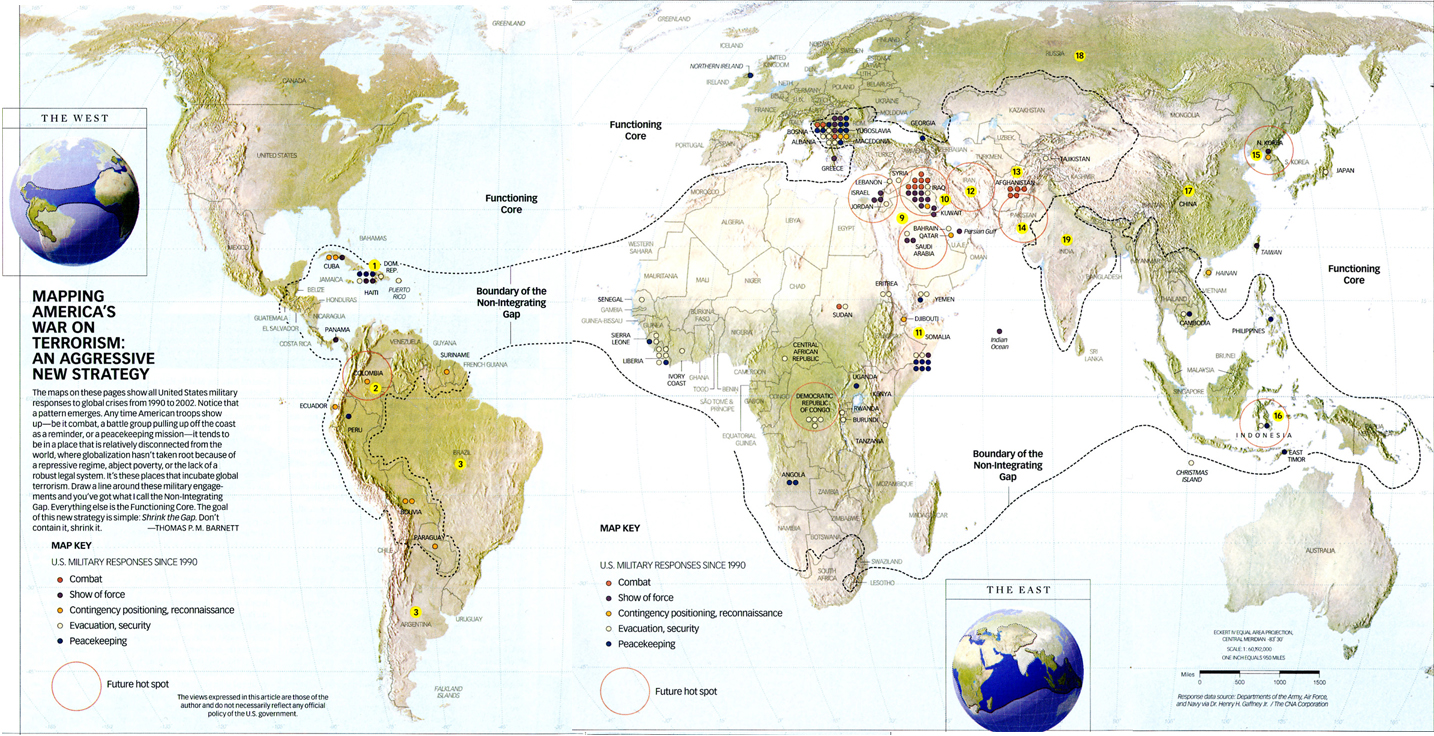
Other Links: 1. "Blast from my past: "The Pentagon's New Map" (2003)."
2. "Mapping America's War on Terrorism: An Aggressive New Strategy."
3. "Of cars and carts: Despite decades of reform, most Mexicans are still a long way from wealth and modernity."
4. "Get Canuckified at Moe's."
5. "Space and Place: The Perspective of Experience."
6. "A Long History of a Short Block: Four Centuries of Development Surprises on a Single Stretch of a New York City Street."
7. "From Metal to Minds: Economic Restructuring in the Rust Belt."
8. "Urban Decline in Rust-belt Cities."

Postscript: Demographer John Weeks also looked at the Economist article about economic development in Mexico:

But the birth rate is not evenly low throughout Mexico, even though it is lower in every state now than it used to be. I created a state-by-state map of the TFR in Mexico for 2000 from the INEGI data, and you can see that fertility is very low in Mexico City and especially in states closer to the US-Mexico border. I used data for 2000 instead of 2013 for the map because these data will reflect the youth population of today--the group of people needing to be absorbed by the Mexican economy. The state of Guerrero, just to the south of Mexico City (albeit over the mountains), and the state of Coahuila, bordering south Texas, had the highest fertility levels in 2000 (as they do still now). So, proximity to the engines of modernization (i.e., Mexico City and the US) does not ensure low fertility. At the same time, the lowest levels of fertility are generally found in Mexico City and its surrounding areas, and along the rest of the US-Mexico except for Coahuila. But you can also see that fertility is below average in the Yucatan peninsula. As the Economist rightly notes, it is the combination of geography and culture that matters, and that is the essence of spatial demography.

Fair to say, Weeks comes to a different conclusion than I do. I make a big deal about proximity to the engines of modernization. Weeks downplays the effects. The two perspective aren't mutually exclusive. Instead, the tension raises a host of interesting research questions.

Wednesday, September 16, 2015

Debunking Texas Exceptionalism: De-Regulation Will Not Save Us

Houston has a de facto zoning problem.

Theme: Geographic stereotypes

Subject Article: "Forget What You’ve Heard, Houston Really Does Have Zoning (Sort Of)."

Other Links: 1. "No Old Maps Actually Say 'Here Be Dragons'."
2. "Houston, New York Has a Problem: The southern city welcomes the middle class; heavily regulated and expensive Gotham drives it away."
3. "Debunking Texas Exceptionalism."
4. "The Shapes of Cities."

Postscript: Unfortunately, ideological thinking drives a lot of academic inquiry. Density is good. Sprawl is bad. Deregulation is good. Big government is bad. The facts are made to fit an a priori conclusion. The author over-interprets the data. I'm most sensitive to the use of normative geographies. Houston's lack of zoning doesn't make the city exceptional. What makes the metro so active to the middle class? Sprawl. Density bad. Sprawl good. See what I mean?

Tuesday, September 01, 2015

The Second Machine Age Is Dying

Get ready for an unprecedented economic boom in the United States.

Theme: Geography of economic convergence

Subject Article: "How New Orleans Built a Bustling Tech Hub in Katrina's Wake."

Postscript: In both the first and second machine age, the economy is geographically divergent and then geographically convergent. The iconic place of divergent first machine age was Pittsburgh with its dominance of steel production:

The 40-year period from 1870 until 1910 marked Pittsburgh’s Golden Age. Favorable geography, unique natural resources and a super-abundance of entrepreneurial talent lifted Pittsburgh to a position of national and international prominence never seen before or since.  Pittsburgh’s growth is a story of heavy industry, specifically steel. Population statistics speak to Pittsburgh’s dynamism during this period. The city’s population grew sixfold in those 40 years, from 86,076 to 533,905. Allegheny County nearly quadrupled, to 1,018,463 residents. The local population growth rate doubled that of the nation. In 1900 the value of manufactured products in Pittsburgh was more than Cleveland and Detroit combined.

1910 was peak Pittsburgh. 1910 was peak divergent first machine age in the United States. After that, the region experienced a long slide that lasted about a century. In terms of manufacturing (the dominant industry of the first machine age), that slide continues in terms of labor market share.

The iconic place of convergent first machine age was Detroit:

For almost a half century last century, Detroit was a boom town. Between 1910 and 1950, few cities grew faster, were wealthier, were more attractive to those seeking success than what became known as the Motor City.

1950 was peak Detroit. 1950 was peak convergent first machine age in the United States. After that, the region experienced a long slide that well could last a century. The automobile isn't coming back, at least in terms of employment.

For almost a half century last century, Silicon Valley was a boom town. The 40-year period from 1950 until 1990 marked Silicon Valley's Golden Age. It was the iconic place of divergent second machine age.

That means we are about 25 years into convergent second machine age. Seattle? Boston? Someplace else? I'm trying to locate the iconic place of the convergent cycle of the second machine age.

Wednesday, August 12, 2015

Ezra Klein Is Transforming Education

Journalists have replaced teachers as the curators of expertise.

Theme: Workforce development and talent

Subject Article: "Ezra Klein Finds Conversations About the Future of Journalism 'Tiresome.'"

Other Links: 1. "Labor Disputes, Wooden Shoes, and Italian Bread."

Postscript: Concerning economic development, I focus on education and health care. The interview with Ezra Klein says a lot more about the future of education than it does journalism. Readers consume content and learn. Klein's business model subsidizes that education. Klein's business model cares more about the quality of the audience than quantity of audience. This is a matter of education, not journalism.