Saturday, February 06, 2010

Rust Belt Chic: Soup Sega

To me, Pittsburgh cuisine is exotic. The first thing that comes to my mind is Eastern European food served up at a local church during a festival celebrating national heritage. In this Sunday's Washington Post, you can find some of that magic:

A recent 10-degree morning is "a good soup day!" says Pat Penka French, ushering a visitor into the humid, fragrant kitchen of the Bulgarian Macedonian National Educational & Cultural Center. The epic wedding scene from "The Deer Hunter" could as well have been filmed in the society's West Homestead brick headquarters, a throwback to the days when immigrant steelworkers founded ethnic social clubs.

The country's oldest Bulgarian organization, the center now sustains itself financially with soup. Its popular Soup Sega -- "soup now" -- is a weekly sale of such specialties as gyuvech (stew) and banitza (feta-filled strudel). The northern Bulgarian spicy tomato soup floats a raft of tiny dill dumplings, while the spinach-and-rice variety, finished with lemon and egg, is French's family recipe from central Bulgaria. "We've had visitors from 44 states and 25 countries," says the State Department interpreter and president of the center. "The soup has opened doors."

Directing the weekly volunteer cooking session is red-haired Angel Roy. Drawn to the center by childhood folk-dance lessons rather than Balkan heritage, she now directs the action while her 9-month-old son, Calder, is coddled by aproned admirers. "I love the camaraderie in the kitchen," she says, "and the motherly advice." Her ingredients stay true to Southeastern European tastes: She uses Bulgarian feta, less salty than that of its neighbors, with dashes of mint and paprika.

I think the described creature comforts would appeal to Gen Y cosmopolites. Rust Belt Chic is the never ending search for authenticity of place. In cities such as Buffalo, thy cup runneth over. It's not for everyone, but I sense a recycling of interest in blue collar culture.

The current globalization hangover might have something to do with the trend. The backlash against suburbia also helps. This is a nationally scaled gentrification project and I can imagine a day in the near future when people lament the increasing rarity of soup sega. The golden age is now.

Friday, February 05, 2010

Wall Street Journal Prints Lies

The New York Post screams, "Exodu$$$! Wealthy flee NJ". Another headline exclaims, "TAXES DRIVE OUT WEALTH". The reputable Wall Street Journal offers this summary:

As states suffer budget shortfalls and move to increase taxes, a study by Boston College’s Center on Wealth and Philanthropy shows how that can cause wealthy families and businesses to flee elsewhere.

That’s just what happened in New Jersey, the center’s study found. It said the flight of wealthy families deprived the Garden State of $70 billion dollars in wealth and some $1.1 billion in expected charitable giving from 2004 through 2008.

To be quite frank, the WSJ journalist (Shelly Banjo) is lying. The report says nothing of the sort:

As context for this section, we have previously concluded that New Jersey is losing wealth and charitable capacity for giving more because of a decline in wealthy households moving to New Jersey in recent years than from wealthy households leaving New Jersey. We have also seen that New York is a major source of households migrating to New Jersey. In the prior section we found that the wealth of households leaving New York decreased substantially in recent years. In this section we examine how many of these households moved to New Jersey as opposed to Connecticut or someplace else.

This is the problem with net migration data. Net out-migration is shorthand for "exodus". For that matter, so is "population decline". The Boston College study is full of useful information that could help inform better policy. Instead, the Wall Street Journal distorts the facts in order to support its own viewpoint.

For the record, I think tax cuts are usually a good idea. But I can explain my position without resorting to misrepresenting research. Also, good newspapers can and will provide an honest summary of the findings:

While the entire Northeast has seen an outmigration of millionaires, New Jersey has seen a disproportionate amount, with fewer moving in to replace them, the study said. The people arriving are younger and less educated than those moving out.

The number of wealthy households moving to New Jersey from Pennsylvania between 2004 and 2008 dropped 45 percent. From New York, the number dropped by half.

I used to subscribe to the Wall Street Journal and recently received a seductive offer to renew. I'm not interested in paying for yellow journalism. I'll stick with the Financial Times.

Thursday, February 04, 2010

Zero Gravity Ohio

The high tax bogeyman is back in the Ohio news. The crux of the argument is the same narrative I see recycled across the United States. The misinformation:

In his recent State of the State address, Gov. Ted Strickland announced his plan to spur job growth through a $40 million Energy Gateway Fund focused on developing "green energy" jobs. What both the governor and the state legislature fail to recognize is that the state's tax climate is driving businesses and individuals out of Ohio.

Unequivocally, the author is describing the tax regime as a push factor. If only Ohio were more like Michigan. That's an actual suggestion after detailing the out-migration woes. The opinion piece isn't all bad. I appreciate the regional focus. No sense in repeating the Wendell Cox nonsense about the exodus from overtaxed Rust Belt. However, I suspect parochial competitiveness is the real reason.


We're as eager as anyone for this recession to be over as anyone is. But in the meantime we're fighting it by out competing other states and welcoming jobs from companies that decide that Indiana gives them a lot better chance to get their money back than Michigan, Ohio, Pennsylvania, or wherever else they are.

Regional cooperation might be at a nadir as the economy begins to recover. Richard Longworth wrote two posts (here and here) about this problem. Protectionist rhetoric is on the rise. I digress. The Tax Foundation is exploiting mega-regional disharmony to push Ohio towards tax reform.

Focus on talent attraction. Taxes aren't the issue. (Via Aaron Renn's Twitter feed) West Michigan has figured that out:

Ann Harten, vice president of human resources and global information systems at Haworth Inc. and facilitator at the Tuesday meeting held at the Haworth headquarters, says that when it comes to recruiting talent, local businesses first compete against the draws of other regions -- not necessarily other companies.

Hot-shot executives who are considering career moves compare metropolitan areas, so they analyze how West Michigan stacks up against such regions as Nashville, Austin and Milwaukee in making their decisions, she says.

When they shared notes with each other, chief information officers and human resources executives at some of West Michigan's largest global companies discovered they were having the same problem with recruiting top-level talent, simply because there was a fuzzy perception of the area. ...

... "A lot of people thought there was nothing in the state except for automotive manufacturing," Stotts says. "There was the perception that the economy was terrible. Anything west of Lansing was thought to be agricultural."

Communities such as Holland, Grand Haven, Muskegon or Grand Rapids were thought to be suburbs of Detroit. "People didn't have any knowledge of any communities in the area. There was a total lack of awareness as a whole. Everybody was facing the same challenges."

The above story tends to get lost in anxiety about brain drain and opens the door for the Tax Foundation to pursue its agenda with a dubious recitation of the facts. If only it were so easy as to simply reduce tax rates. It isn't. But that option is cheaper than place-based strategies that are fundamentally designed to reduce out-migration. The sunk costs represent a redoubtable risk.


Enter Glen Norton, a developer who became the senior business development consultant of Hamilton's downtown renewal division.

Norton and three investors, using only private money, bought the three-storey building that started life in 1887 to house soldiers from the armoury across the street.

"The idea is that creative professionals need a small space and benefit from working in close proximity to each other," Norton said.

"There's that synergy, that sharing of ideas, that energizing each other, that opportunity to do projects together."

Norton and his partners have set out to show one can take an old building in downtown Hamilton, fix it up and repurpose it and it works as a business model.

"We worked backwards to what a traditional developer might have done. We said, 'Let's find an old building and then let's figure out what we can use it for.'"

The ground floor, which includes a magnificent terrazzo floor and 11-foot ceilings, will house a boutique cafe and a gallery. ...

... The second and third floors will contain 20 studios. Half of them have already been snapped up, even though the owners have not spent a cent on advertising. One web designer wants four.

"It's been pure word-of-mouth," Norton said.

That's how shrinking cities will get back on the map. There has to be a buzz from a trusted source. Relocation is risky business, which is why most people don't move very far from their place of current residence. Or, they follow friends/family to a boomtown or struggle to make it in a first class global city. Understanding the rationale behind this migration is critical to economic redevelopment.

Along those lines, I rather like Mike Madison's recommendation to Pittsburgh:

The business community and local government should stop preaching to the local business choir ("Isn't Downtown Such a Wonderful Place?") and make meaningful and public efforts to bring people to the region from outside Pittsburgh. Move here, please! Re-invest in Pittsburgh's sister cities program (here's the list, including what I believe is the newest: Danang). Promote a "sister city of the month" campaign in the region that features business, arts, culture, and citizens of our urban buddies. Study how other post-industrial cities have attracted immigrants in the last 40 years. Bring more fresh eyes and fresh voices to Pittsburgh -- the New Girl herself being Exhibit A of that sort of thing.

The boldfaced sentence is the part I most appreciate. Any "meaningful" effort starts there. That goes for tax reform advocates, as well. Show your readers a working example, "Lower taxes in Michigan plug brain drain!" Good luck with that. As for attracting immigrants, the authors of "Hollowing Out the Middle" claim Iowa's campaign worked. There is a be-careful-what-you-wish-for asterisk in terms of community integration, but the numbers are promising.

With a few exceptions, Rust Belt cities struggle to attract talent. That difficultly takes a back seat to talent retention. I applaud West Michigan's fresh thinking and open inquiry. Ohio could learn a few things from its neighbor to the north. And I'm not talking about tax reform.

Wednesday, February 03, 2010

TechBelt Tidbit

Sometimes a pithy post can remove the writer's block. Congresswoman Kathy Dahlkemper (her district includes Erie) has expressed interest in the TechBelt Initiative:

As your representative in Congress, I will always advocate for our region’s businesses and industries. We must identify the strengths of our businesses that are already here, helping them grow and create new jobs. Companies like General Electric Transportation represent the foundation of our local economy, and we must continue to do everything we can to ensure their success.

Working with my colleagues, we were able to secure funding for Amtrak expansion, giving GE the chance to bid on 54 new energy efficient locomotives—a significant business opportunity for GE and for the workers in our region.

But our local economy cannot be reliant on one company; we must diversify to grow businesses and job opportunities in various fields. Our community’s farms, manufacturers, technology leaders, retail and commercial services, health care providers, educators, and tourism are all vital to our future. A diversified economy will have the strength and the resilience to help us sustain the natural ebbs and flows of the broader world economy.

That’s why I’ve led the effort to involve the 3rd District in the [TechBelt Initiative], a collaboration between Pennsylvania and Ohio to spur innovation and growth in our regional economy. Through this initiative, we can help make Western Pennsylvania a center of new technology, expanding businesses here and bringing new enterprises to our communities.

TechBelt: 2
Power of 32: 0

Tuesday, February 02, 2010

The Next Pittsburgh

Hamilton (Ontario) is hoping to pull off a Pittsburgh-like makeover. First up, promote yourself as family friendly. The eye is on Toronto refugees, people leaving the big city for various reasons. Ironically, that includes charter members of the creative class:

Now, the venerable Jamesville building is the latest target of a metamorphosis driven by a new wave of artistic entrepreneurs, and dreamers -- the creative class -- who believe Hamilton is the place to be.

"Toronto is already quite successful. And Toronto is full," said Martinus Geleynse, a 25-year-old local film producer and musician. "The beauty of Hamilton is that it's a frontier, it's a Wild West, and you can create your life here. And you can make money here."

The city has long suffered an artistic brain drain as Toronto siphoned off the cream of the creative class, he said. That now is changing as the trickle of artists, who have quietly been setting up shop in areas such as James North, threatens to become a flood.

"All the kids left here for the cool city," Geleynse said. "Now anybody can come here and be one of the cool kids.

"In Hamilton, there is a reason to get up every morning and contribute something." ...

... Hotel Hamilton is being managed by Jeremy Freiburger, executive director of the Imperial Cotton Centre for the Arts.

"People are moving here (to Hamilton) from Toronto, Ottawa, Vancouver, and they're moving here because rent is cheap, buying is cheap and this is a town where you can actually afford to experiment," he said.

"As an artist, you can make money, but you are not forced into the grind of overly commercialized activity all the time."

I don't know to what extent data might back up the claims. I see more and more evidence (albeit anecdotal) of migration away from the big global cities. Spiky World is getting flatter by the day, at least in the richest countries. Rust Belt Chic is ascendant.

The quintessential reverse migration is occurring in Japan, where a moribund economy is undermining traditions. It's also making dense city life a lot less attractive. Flat Worlders are discovering the splendor of the "slow-life":

Japan may not seem the logical choice for those seeking peace and tranquillity, but as the cities draw in the countryside's young and property prices fall, it is now the best place on earth to find your own rural paradise.

Oh, to be in Provence, that Jerusalem of slow living revealed by the gospel according to Peter Mayle. Shame, though, that property is now so exorbitant and burglary angst so pervasive; and that expat demands for broadband have left France Telecom staff so hyper-stressé. If not volatile, dysfunctional or unwelcoming, most other Edens are equally overpriced and crime-ridden. So where else could a slow-life pilgrim go? The last place one might guess is Japan. For as everyone knows it's an expensive sardine can encased end-to-end in concrete.

Granted, Japan's postwar "economic animals" tried their best, improvising with golf greens and tree farms where they couldn't subdue nature in concrete. But in six decades you can only pave so much of a mountainous archipelago that extends 2,500km. Now, with vast pockets of rural beauty still "unimproved", Japan's long march to "progress" is running out of steam. And, as aspiring slow-lifers are finding, it's creating some remarkable opportunities.

Apparently, slow-lifers are finding similar opportunities in places such as Hamilton and (according to Monocle) rural Germany. Saskia Sassen observed the rise of global cities and wrote about urban economies of agglomeration. I look at Pittsburgh (better yet, Youngstown) and see a new urban geography of globalization, one of arbitrage.

Rural villages and shrinking cities are the new frontier. This is the new talent migration. Chicago Poles are returning to the homeland in droves. These strange patterns are becoming more common, challenging Richard Florida's map of the world. Forget Toronto. Hamilton is where the cool kids are moving.

Burgh Energy Report: Regional Economic Geography

The last two weeks have been a deluge of meaty articles about shale gas. There is another sector news of interest, such as the White House's backing of nuclear energy. But shale gas innovation is the main agent of transformation.

Over the last few years, the natural gas industry has undergone cataclysmic change. The world that produced talk about a pipeline from Alaska to the contiguous United States no longer exists. Energy security concerns have shifted and climate change is now a big part of the geopolitical equation. Most remarkably, the country is now poised to become a major exporter of natural gas. That article also includes an important tidbit about the economic geography of domestic shale gas extraction:

Shale exists throughout the world, in many geologic basins, and the industry should be able to exploit it. John Curtis, director of the Potential Gas Agency at the Colorado School of Mines, which is affiliated with the Potential Gas Committee - a group considered by industry and government for expert information on the gas resource base - notes there is nothing magical about the shale in the US. That said, the US does have an edge in that it is well suited for rapid development, with much gas in lightly populated areas and a web of existing infrastructure to bring it to market. And the world experts at getting to this resource are in the US - something nobody in the industry is downplaying.

The drilling boom happens in places such as De Soto Parish in Louisiana. The Pennsylvanian equivalent might be Indiana County. This pattern suggests that drilling in the heart of Pittsburgh is unlikely and that most of the activity will take place far from population centers.


A one-time cow town, oil town, and even a tent city (when it was founded during the 1889 land rush), Oklahoma City is urgently trying to reinvent itself as the next big city in America. If "America is the Saudi Arabia of natural gas," as T. Boone Pickens puts it, then Oklahoma City is its Riyadh. It's home to three of the largest independent producers--Chesapeake, Devon, and Sandridge--which are helping to underwrite its urban ambitions.

This afternoon, Sandridge will unveil an over $100 million expansion of its downtown headquarters across three city blocks. The plans include a renovated 1960s tower by architect Pietro Belluschi, a restored Braniff Building--built in 1923 by the brothers who started their namesake airline--and a public park recycled from a pair of windswept plazas. The New York-based architecture firm of Rogers Marvel will incorporate features like green roofs, native plantings, and storm-water management to meet LEED standards. Sandridge, which is the youngest and smallest of the city's gas giants, is touting the project as the largest private downtown development in its history--for the time being, at least.

What's unusual about the plan by local standards is that Sandridge is reusing existing buildings, rather than relocating to an exurban campus. Part of this has to do with timing--the company acquired a million square feet on the cheap when yet another energy firm, Kerr-McGee, was sold to Anadarko Petroleum in 2007 and immediately left town for Houston. Sandridge CEO Tom Ward had considered a campus, but found it was both too expensive and too inflexible for his plans to grow the company from 600 to 1,500 employees. Ward went against his own employees' wishes by electing to remain downtown instead. "Their first response was that it was going to be a longer commute, and the idea was not one they embraced originally," Ward says. "And then the Thunder came to town and a lot of things started changing." (Ward is also a minority owner in the Oklahoma City Thunder, the city's two-year-old NBA team.)

Renaissance Oklahoma City is built on shale gas. Pittsburgh presents a much more diversified portfolio, but the impact of the Marcellus Play could (should, in my opinion) be just as profound. Pittsburgh is the emerging center for the energy-starved Northeast. Think Houston, Denver, Calgary, now Oklahoma City, and then Pittsburgh.

Pittsburgh's strengthening position in the global energy economy might spillover into, of all places, my hometown of Erie. John Elliot would like to see his city become a major inland port. It's a bold idea from a risk averse town. The Erie advantage:

The Economic Development Corp. of Erie County is convinced that Erie is well-positioned to become a global player in the multibillion-dollar business of moving things.

The region is close to interstate highways and the Canadian border, and sits on Lake Erie.

It has an expanding airport, it is amply serviced by railroad lines, and about half of North America's 534 million people live within 500 miles of Erie County.

Local logistics entrepreneur Jim Berlin has already voiced his support for the project. You might say that Erie already has talent and know-how to pull it off. I have a few concerns, such as the existence of a better port in Cleveland. Erie might want to read this ferry feasibility study. The location of a major multi-modal logistics hub might be better placed elsewhere.

The connection I see between Energy Burgh and Erie is the transport of shale gas to market. Pittsburgh will anchor the inland economic growth and a corresponding port makes sense to me. For that matter, keep an eye on the doings in Youngstown. The Mahoning Valley is another potential logistics hub. Unlike Erie and Cleveland, that area has its political act together and offers similar geographic assets (sans the waterway). Possible synergy between Erie and Youngstown?

Case For Talent Attraction

Even if your region could retain all of its graduates, that would still put your hometown at an economic disadvantage. Consultants travelling around the country telling towns, cities and even states how to keep natives closer to home are offering bad advice. Renaissance Chicago is a good example of the talent attraction imperative:

Chicago’s turnaround following the 1980s was remarkable in that a fundamental restructuring supported it. Specifically, though the metropolitan area shed much of its manufacturing base, its work force shifted increasingly into professional and business services. In response, many Chicagoans crafted a new image of their metropolitan region: Instead of being a “hog butcher for the world” and the regional locus for manufacturing and transportation, Chicago (at least in the mind of its citizens) was moving into a new role as a global city, one whose economic connections were being forged with other world business capitals. Chicago was seen as a city casting off its roots for something better.

During this time, a central city revival contributed greatly to the wider metro economy. For example, Chicago became a magnet for young educated workers who occupied jobs in the rapidly growing business and professional services sectors. The central city’s quality of life and amenities reputedly brought in “knowledge workers,” in turn attracting companies or those parts of companies that desired access to the young, highly skilled labor pool. The number of central area jobs in professional and business and financial services grew robustly; and the city’s unemployment rate improved, gaining ground on that of its suburbs from the early 1990s onward. The central city gained population during the 1990s for the first time (counting the decade’s total) since the 1940s, although immigration of lower-skilled workers from Central America accounted for a majority of the gains.

I highlighted the key sentence. In order to grow and prosper, Chicago first needed to destroy itself. I would call this a greenfield proxy in a classic brownfield city. But Chicago didn't become a big player on the global stage as a result of holding onto more graduates. It did so by expelling them and "casting off its roots." In effect, the Inner Loop transformed into a global space and Real Chicago retreated to isolated neighborhoods that would see little of the prosperity. Such is the urban geography of globalization.

I think Pittsburgh is at the same crossroads Chicago was in the 1980s. However, there seems to be little interest in "casting off its roots". Perhaps Pittsburgh is the harbinger of a new economic redevelopment paradigm. I doubt it.

Now more than ever, trade follows migration. The most dynamic companies chase deep talent pools, not the reverse. The inspiration for this blog post is a study titled, “The Trade Creation Effect of Immigrants: Evidence from the Remarkable Case of Spain”. There is a handy summary here, along with key references to the supporting research literature. The results:

We argue that there is evidence of an export-creation effect of immigrants in Spain so that part of the increase in exports was caused by immigrants themselves. Through business and social networks, expatriates increase the diffusion of information and reduce the cost of doing business with their “mother” country. The presence of immigrants has increased the number of exporting Spanish firms, has promoted exports of sophisticated manufacturing goods and has increased exports with countries “culturally” different from Spain. This is an important and rarely considered benefit from immigration for the host country.

Chicago aggressively imported export opportunities. A parochial city such as Pittsburgh will not generate such a dividend. In fact, I would go so far as to argue that the balance of migration takes a back seat to functional talent churn. Better to shrink and attract more outsiders than to grow via better retention.

Monday, February 01, 2010

Natural Experiments Of Rust Belt History

As a geography graduate student, I took data analysis with budding psychologists. Mastering research methods in another discipline is quite useful for crafting a clever line of inquiry. Furthermore, the professors leading the course trotted out one peer reviewed article after another and highlighted tragic flaws in the design. Mind you, this was published work. Burned into my psyche is the careful crafting of research questions.

Such a scholarly approach is central to Jared Diamond's new book, "Natural Experiments in History". Appropriately, a history professor interviews Diamond about the strength of the comparative method (i.e. natural experiments). For historians, the technique is blasphemy. For Diamond, it is wonderfully illuminating (see "Guns, Germs & Steel"). The conversation is an hour long and offers a number of fascinating insights.

I learned about the podcast from blogger David Campbell, who writes about economic development in Atlantic Canada. Campbell tries to employ Diamond's methodology and thinks about a natural experiment that could help explain why his region is chronically the poorest:

If you used his model you might find that Atlantic Canada might have been far more prosperous as a separate country. If you read Donald Savoie’s work, you see clearly that many of the leaders at the time in Atlantic Canada predicted this region would wither and be entrenched as the poor region of the country due to Upper Canada’s political domination. And it’s hard to deny that we have become the entrenched poor region of Canada in the intervening years.

To many folks this is an inevitable consequence of history. The Maritime region is in a bad geography. It has relatively little oil and gas (at least until now). It is physically far from the centres of power and control. Too bad. Every country has poor areas. Accept your destiny.

But I think that is too simplistic. If I had the cash, I’d get a guy like Diamond to look at it. Why didn’t Halifax become Boston? Why did this region (and I guess we can include northern Maine) stagnate while other areas boomed?

I'll start with the secession question. Ideally, you'd have a region very similar to Atlantic Canada that chose not to join the Confederation. Controlling all the other variables, you could trace the effect of joining Canada. Or, you could dig up a similar situation somewhere else in the world and see what happened.

I rather like the Boston-Halifax comparison. That got my wheels turning concerning an effective line of inquiry. The problem is the international border. The dominant effect would be national geography. That's less than ideal, but could suggest a few policy avenues.

A better design would be economic variance within Atlantic Canada. Such a geographic scope makes it easier to control more variables. The places compared should have the same advantages and constraints.

This can be applied to the Rust Belt. Sean Safford's "Why the Garden Club Couldn't Save Youngstown" is Diamond-esque. Youngstown (Ohio) and Allentown (Pennsylvania) are two similar cities with diverging economic fortunes. Given the research design, Safford is able to draw some useful conclusions about the effect of social network on economic development. To offer a critique, I wonder about the effect of Allentown's proximity to NYC. Might two similar cities in NE PA provide a more rigorous comparison?

Settling on a common geography isn't easy, at least as far as academic standards are concerned. I think blogging about research design is a good solution. I've floated the following idea a few times concerning the Sun Belt advantage. How do Rust Belt cities located in the Sun Belt compare to Rust Belt cities located in the Frost Belt? My hypothesis is that the diverging economic fortunes of the two regions is mostly a result of brownfield versus greenfield development opportunities. In other words, the difference is in the legacy costs.

I remain unconvinced that policy in Sun Belt states explains much of anything. Using Diamond's methodology allows for easy dismissal of the promoters of tax reform. Why else would Pittsburgh be outperforming Sun Belt industrial cities such as Birmingham? In this regard, the Wendell Cox production "Empire State Exodus" is just awful. The conclusions are not to be taken seriously.

When I discuss brain drain, I tend to use the comparative method. Relatively speaking, just how bad is the out-migration of talent in Northeast Ohio? Using net-migration data torpedoes the analysis of retention policies. What you are measuring doesn't match your research question. Joe Cortright made this mistake when addressing his Akron audience. Doing so undermined his recommendations. Such oversights are common and I suspect most of them are unintentional. As Diamond contends, and I would confirm, graduate student training is hit-or-miss. You needn't be an expert in research design to get tenure or make a lot of money as an economic development consultant.

Sunday, January 31, 2010

Emerging Brain Drain Narratives

Globally, the paradigmatic policy shift in workforce development is aptly summed up in the reframing of brain drain as brain circulation. Domestically, greater demographic detail complicates the usual hyperbole about a talent exodus. The debunking of rural brain drain continues to disseminate:

“Rural America needs to rethink its description of gains and losses,” Winchester said. “If rural America is losing high-school educated youth (the brain drain) and replacing them with those (who) at least have a bachelor’s (degree), isn’t this a brain gain?”

The new arrivals have other advantages, according to the University of Nebraska researchers: “The majority of the newcomers are in their prime earning years, so they are increasing the labor force in the region. Many new residents possess professional occupation skills. … Many were also involved in their previous community (and) bring volunteer and leadership experience.”

Winchester said his own findings “remind us that the changes we witness across rural Minnesota are complex and reflect not just challenges, but significant opportunities.”

The counter-intuitive findings deserve further scrutiny. They help to challenge our dominant assumptions. Attempts to plug the brain drain tend to be knee-jerk reactions. We could do a much better job of defining the problem.

At first blush, an article in today's Worcester Telegram & Gazette reads like a talent retention success story. Other shrinking communities would do well to take a closer look. However, I see evidence of a poorly defined baseline:

As with those elsewhere in the state, Central Massachusetts residents are most likely to stay close to home if they grew up here. A 2005 survey conducted by The Research Bureau of Worcester found that about 40 percent of area college graduates planned to stay in Central Massachusetts after graduation, roughly the same share who lived here in the first place.

The journalism employed is impressive, the analysis surprisingly sophisticated. The perception of "exodus" is challenged at every turn. The result is something Worcester can use to craft better policy. I didn't expect anything of the kind after digesting the title of the piece, "‘Brain drain' exodus wanes: Education, foreigners shore up talent pool". My impression is that all the concern is either overwrought or misplaced.

The focus seems to have been on population, not educational attainment. On the latter score, Massachusetts continues to excel. The investment in human capital is generating dividends even if the number of people living in the Worcester region fails to scream boomtown. Back to the article:

Yet recent data suggest the state's pool of young talent is far from evaporating — in fact, it is bigger than ever.

“It's sort of a positive message because a lot of the discussion before … was why are people leaving, and what's making them move away?” said Heather Brome, a senior policy analyst at the Federal Reserve Bank of Boston's New England Public Policy Center. Instead, policy makers “should be thinking broadly about how to expand the skilled labor pool.”

Like much of the rest of the country, Massachusetts is still aging as the baby boomer generation retires and fewer young people take their parents' places, Ms. Brome said. Between 1990 and 2007, the population in Massachusetts of young adults — 25- to 39-year-olds — shrunk by 19.4 percent to 1.28 million.

The Federal Reserve Bank system is at the forefront of researching talent migration in the United States. For reasons beyond my grasp, this wealth of information is rarely referenced. Instead, consultants from a variety of backgrounds have rushed into the void and retarded the development of ideas that would better revitalize our shrinking cities. The result? Sean Safford is screaming for the head of Richard Florida.

In that regard, I think the backlash against the creative class cult is useful. I wouldn't dismiss Safford as representative of the rabble with nothing more than an ax to grind. The criticism aimed at Florida and his evangelists is warranted. Florida is directly influencing economic development policy in Ontario. The 3Ts narrative is popular thanks to the aggressive selling of the ideas. At the rotten core of this entire enterprise is the flight of young talent from Pittsburgh, a gross mischaracterization of the challenges facing that region. That's why CEOs for Cities boosters are still clamoring for more effective retention of local graduates.

That dog won't hunt and we have gobs of data at our disposal to prove it. Yet we insist on ignoring the work of the Fed and repeat the same mistakes ad nauseam. At this point, I don't trust anyone spewing forth net-migration statistics because I know better numbers are readily available. I'm increasingly convinced that the deceit is intentional.

Thursday, January 28, 2010

Post-Recession Migration

Some demographic news out of Virginia may indicate that geographic mobility in the United States is ready to increase. Typically, migration is a lagging indicator. The exception to this rule is acute crisis (e.g. Michigan). The Great Reset will take shape during 2010. We should find out relatively soon if Pittsburgh will be among the new winners emerging from the economic shakedown. I'm betting it will, but I'm guessing like everyone else.

More certain is a populist backlash against immigration. About two weeks ago, GSP Consulting wrote about economic supercycles. Most people would agree that we're emerging from the nadir. I would argue that we are entering a period of stagnation, also known as the "B-phase". GSP sees an "A-phase" scenario. From where I sit, I don't see a geopolitical context that would support such an assertion. Regardless, the initial period of economic recovery is the most politically unstable. A good example of the growing populist sentiment is the Massachusetts election of Republican Scott Brown to the US Senate or the current mood in Davos.

Labor market protectionism is on the upswing and will frame the debate about US immigration reform. Concern about this direction is already apparent:

Several months ago, James Sherk, Bradley Fellow in Labor Policy in the Center for Data Analysis at The Heritage Foundation, and Diem Nguyen, a Research Assistant at the Heritage Foundation made a compelling argument against adding regulations to the H-1B program, stating in their belief, this would represent a serious setback to U.S. Other thought leaders, academics and captains of industry here in the U.S. have echoed that sentiment. While their point of view is that America's loss is the world's gain, I politely disagree with that assertion because I think it represents only half the argument. I believe that any form of protectionism is dangerous and this age of globalization, the proposal to abolish or dramatically reduce H1-B visas hurts our global economy, not just America's.

There are indications that the bunker mentality is hurting US innovation and business. Canada couldn't be happier about the frontal assault on H-1B visas. I predict an exacerbation of existing talent shortages. Ironically, this should benefit Pittsburgh. Silicon Valley is much more dependent upon foreign-born entrepreneurs. This is one of the reasons why I'm bullish on Pittsburgh as the global economy improves.

I'm not in favor of greater restrictions on immigration. But the best supporters of policy liberalization are going to do is moderate the protectionist sentiment. The result will be tremendous stress on workforce development programs. This will help inform a sluggish recovery and draw out the B-phase.

Wednesday, January 27, 2010

State Of The Disunion Address

Richard Longworth beat me to the punch with his speech about Rust Belt discord. President Obama's national pep talk is just a few hours away and I'm thinking about a literal "state of the union". Dominating my Google "rust belt" query is Ohio's State of the State. How does Ohio separate itself from its underperforming neighbors?

The question itself is indicative of the parochial demon Longworth exorcises. Political legacy costs are killing the Midwest and all Gov. Ted Strickland does is reinforce his state as a cul-de-sac of globalization. Ohio is surrounded with economic redevelopment:

Recently, this typical American ingenuity and entrepreneurial energy has been demonstrated in the growth of knowledge-based industries, such as Genentech and Google. Today unheralded individual communities are taking charge of their own futures through a variety of exciting initiatives that are emblematic of the spirited capacity of Americans to reinvent themselves.

Take Pittsburgh for example, where the combination of Carnegie Mellon University’s pioneering robotics program and remnants from the city’s once strong industrial base is fueling the development of the next generation of robotics, giving the city bragging rights to becoming the Silicon Valley of “droid design.”

Meanwhile, in Warsaw, Ind., local companies account for approximately one-third of the world’s orthopedic device market. In Michigan, $1 billion in federal grants are being used to accelerate the development of next-generation batteries and electric vehicles. In an effort to further fuel the green movement, Midland, Mich.-based Dow Chemical Co. is investing $500 million through its own venture fund in public health, clean technology, and water products.

San Diego witnessed this organic phenomenon with the growth of both wireless information technology and the life sciences clusters that sprang up adjacent to UC San Diego. Our region continues to grow innovative clusters in new and converging technologies such as clean technology, health care IT and biofuels. Oil giant Exxon Mobil Corp., as part of its $600 million investment in renewable energy, has teamed with the San Diego biotech firm Synthetic Genomics Inc., to research and develop next-generation biofuels produced from sunlight, water and waste carbon dioxide by photosynthetic pond scum.

But even in collaborative regions like these there is no platform that regularly brings together the four key players: the research community, which is developing the technologies that will shape the businesses and jobs of the future; the entrepreneurs and investors, who can turn a promising technology into a business; the economic developers, who focus on and use resource allocation and business policies that can assure economic prosperity, and the educators and workforce training organizations, which focus on the general and specialized skills needed in globally competitive industries and services.

Balkanization is the rule, even in the most successful regions. However, the Rust Belt is king of zero sum thinking. Mexico can only boom if Michigan busts. Brain drain Detroit informs brain gain Houston. This is the dominant economic paradigm:

Realistically, income tax response gets more elastic as the tax region gets smaller. Oregon borders two states with attractive migration possibilities. California's taxes are no bargain--but Oregon's relatively lower tax rates may have attracted wealthy individuals and businesses that will now find it not so attractive.

Zero sum scenarios follow a distance decay model, a simple way to understand the benefits of regional consolidation. Work with your neighbor and eliminate the most vexing economic tug-of-war. Cleveland is waging a death struggle with Pittsburgh, not Shenzhen.

The US Constitution isn't a drag on the TechBelt. Don't blame neoliberalism, either. The popular scapegoat is globalization.


Luring Expatriates Back Home

Last week, I had an email exchange with a journalist who writes for a major Midwestern newspaper. He expressed interest in boomerang initiatives and applying best practices in his own city. He is looking for success stories and I'm not aware of any in the United States. Some promising news in the Great White North:

Despite a lacklustre economy, 25 British Columbia technology companies with an average revenue growth of 75 per cent were named to this year's Ready to Rocket list. ...

... [Reg Nordman (founder and managing partner of the Vancouver-based Rocket Builders)] said the list, which has a global following, was instrumental in convincing British Columbians who had moved elsewhere to return to the province. He said tracking the success of B.C. companies and sharing it helped attract people back.

"We were able to repatriate some extremely qualified people back to B.C.; we were able to reverse the brain drain a bit," he said.

A bold claim that I can't substantiate, but I've been tracking a similar talent migration to Youngstown. The success of the Youngstown Business Incubator (YBI) has garnered the attention of the Mahoning Valley Diaspora. National publicity, such as this positive recognition in Entrepreneur, is resulting in talented expatriates contacting YBI CEO Jim Cossler.

There is considerable latent interest in returning home. The lack of knowledge about opportunities (and how to best pursue them) is a big barrier to this talent flow. What kind of labor shortages are forcing local companies to go outside the region in search of employees? The news of Google's relocation and expanding footprint in Pittsburgh sparked at least one of my readers to inquire about the tech job market. Google hiring sends a strong signal to the most geographically mobile because the company has a globally recognized brand.

I'm inclined to buy Nordman's hype about luring brains back to British Columbia. It is probably a very modest number. That doesn't matter to the talent starved tech companies Nordman's business promotes. The fast growing have pressing needs and highly skilled expatriates are only too glad to fill them.

Tuesday, January 26, 2010

Foreclosure Pittsburgh

The best place for home foreclosure bargain hunting is Pittsburgh, according to Zillow:

Of the 16 markets we analyzed (using data from the end of the third quarter), the Pittsburgh metropolitan statistical area (MSA) showed the biggest discount for foreclosed homes, with buyers currently paying 59 percent less for foreclosures than they would for similar non-foreclosures.

However, there aren’t as many foreclosures to choose from in Pittsburgh as there are in some other markets. Ten percent of all sales in September were sales of previously foreclosed homes. That’s decreased even more, with 8 percent of sales in November being foreclosure re-sales.

The numbers might speak to the resilience of the Pittsburgh real estate market. There is such a bizarre confluence of factors in the region. Zillow provides a white paper detailing the methodology. I'm not that intrigued, more hoping someone wiser in such matters will comment.

Talent Attraction Expert Joe Cortright

The talent dividend bandwagon made a recent stop in Akron. Economist Joe Cortright presented his City Vitals work and you can view his talk here. I watched the entire event last night and I didn't note anything groundbreaking. In fact, I'd argue that the policy narrative is flawed. The recommendation for Akron:

''I'm a talent-attraction expert,'' said Cortright. ''I know that the quality of life in a city is very important in [the ability] to anchor talent to that city.'' ...

... ''It's not enough to educate your young people; you also have to pay attention to talent,'' Cortright said. ''You must build a community that makes them want to stay. That's a big challenge in the region because the most mobile tend to be the most entrepreneurial.''

Cortright said ''close-in neighborhoods are the key to keeping young talent. Young people are much more likely to choose to live in close-in neighborhoods.''

Dr. Luis Proenza, president of the University of Akron, said he is proud of the region's ability to keep UA's products.

''We have 28,000 students each year at the University of Akron,'' he said, ''and 85 percent will stay in the region after they graduate.

''We realize with the young, educated people that location matters. So long as they stay in the region, because it's the region that defines our economy and will define the long-term economic vitality for us all.''

Cortright thinks that Akron has a talent retention problem. He's wrong, as Dr. Proenza makes clear. Cortright is peddling more of the same brain drain nonsense. Akron has seen this act before from Next Generation Consulting. I'd expect much more from a self-professed talent attraction expert.

This misunderstanding stems from the sloppy analysis of net migration data. Once again, negative numbers are communicated as out-migration, an exodus of talent. Name one US city that has posted gains among the college educated thanks to improved retention. Makes me wonder why Cortright didn't have any recommendations for Akron talent attraction. For a possible answer, see yesterday's post.

Monday, January 25, 2010

Beware Of Sea Serpents

Before I rip off other people's blog posts, I'll tell my own story. There is (at least there was) a consignment store in Johnson, Vermont that I used to frequent back in the day. I bought a t-shirt there that screamed "Locals Only" with a picture of a junkyard dog doing its best to protect the parochial boundary. I thought the violent image hilarious. As a wayward twentysomething, I was all too familiar with such warnings. I appropriated the iconic statement as a form of irony and garnered many compliments for my attire among my peer group.

Instead of "Beware of Dog", I titled this blog post "Beware of Sea Serpents". I'm referring to another great piece of cartographic history published at Strange Maps:

This [map] shows the next best thing: dissuasive cartography. Its actual title is Cautious Cartography, as it appeared in the August 1940 issue of the Irish satirical magazine Dublin Opinion. The map purports to portray Ireland in as unappealing a perspective as possible. The text accompanying the map explains how cartography may be at least partly to blame for Europe’s misfortune:

Feeling that the present unrest in Europe may have been largely caused by the well-intended, but highly mistaken policy pursued by countries of boasting about their natural advantages and attractions, a policy which has had the not unnatural result of exciting the cupidity of other countries, our Grangegorman Cartographer has designed the above map of Ireland, which is calculated to discourage the inhabitants, much less strangers. The trouble is, he feels, that, even as depicted, the country still looks more attractive than the rest of Europe.

Locals Only.

Keeping outsiders at bay is as easy as flip-flopping the appropriately named Greenland and Iceland. But what if your town wants to attract newcomers? As Politics and Place reminds us, not so easily done:

I've been able to convince myself that I could live in a lot of places that many people would run away from (Baltimore, Detroit, Cincinnati, etc.). But in all honesty, I'm really not sure I could take a position in Dayton. The city is in a very awkward place, both geographically (sure it's only an hour and a half drive, but if you want to go carless that's not a whole lot of help to you), and population-wise (at around 150k, it isn't really able to offer the critical mass that I think a lot of young people are drawn to.

I understand that Dayton has great quality of life measures, but so do plenty of larger places. The articles on the subject in the local paper are a healthy rational understanding at the issue, but they don't completely get it. Yes, Dayton has universities and Wright-Patterson and all of the other things that cities talk about in glossy brochures, but it wasn't enough. There is something apparently missing in Dayton, some X factor that every city wants to have.


Transportation costs were high, and flights to and from the airport often required “multiple hops” for customers and employees. And attracting top talent was a struggle, he said. “We had a very difficult time recruiting people to live and work in Dayton.”

Most (perhaps all) Rust Belt cities have Dayton's problem. Richard Florida terms it the "means migration". Brains are pooling in a few select places, which is radically different from the United States of the 1970s. Once this path dependency is established (i.e. beware of sea serpents), it's hard to shake the reputation. That's why Ann Arbor suffers in the shadow of Detroit:

And despite Ann Arbor's educated work force, employers here find Michigan's reputation as a failing manufacturing economy can deter potential hires from moving to the state.

At HandyLab, an Ann Arbor firm that makes a DNA-analysis device, Chief Executive Jeffrey Williams says he has had a hard time finding Ph.D.-level workers with highly specialized skills. His company, which has doubled to roughly 60 employees in the past year, has 10 job openings.

"It's definitely gotten much harder with all the stigma around Detroit," he says. "Somebody tries to pigeonhole us as Detroit, we say, 'No, it's Ann Arbor, it's a completely different environment.' "

I've discussed that anecdote before, but it deserves to be repeated. The Rust Belt is a victim of means migration. That's why I suggest the megaregion explore residual migration. If Ann Arbor is having trouble attracting talent, then what hope can we have for Dayton or Youngstown?

For most people, the mental map of the Rust Belt looks a lot like the Cautious Cartography of Ireland. I think this applies equally well to city living. Suburbanites imagine sea serpents swimming around in the urban core just as they might fear killer dogs on the loose along rural roads. Locals only, buyer beware.

Saturday, January 23, 2010

Brain Drain Report: Residual Migration

I was prepping for a phone conversation with Ohio State Senator Joe Schiavoni concerning his bill designed to help plug the brain drain. My blog is an archive of this kind of information and I searched for tax credit proposals in other states. As I expected, the idea isn't new. Someone needs to tell that to West Virginia. Better yet, voters and politicians would be wise to listen to a fellow resident:

Still, the state can’t focus solely on financial incentives to attract educated young people, said 26-year-old R.B. Seem, a Martinsburg banker who leads the Young Professionals of the Eastern Panhandle.

“If it’s just about money, I’m not sure the tax breaks are enough to make a difference for a lot of young graduates,” said Seem, vice president of lending at MVB Bank in Martinsburg. “If someone graduates with a teaching degree, and they can work here for $30,000 or earn $50,000 in Loudoun County [Virginia] and money is the big consideration, then a break on state taxes probably isn’t going to persuade someone to stay.”

But Seem said West Virginia’s appeal goes beyond money.

“I didn’t move back to West Virginia for the money,” said the Martinsburg native who lived in North Carolina and Washington, D.C., before returning to the Panhandle in 2007. “I know a lot of young people feel the same way: It’s about what West Virginia offers. I like my life here.”

Given the tremendous pull of agglomeration economies, states such as West Virginia should focus on residual migration. As Mr. Seem explains, a tax credit isn't going to discourage native talent from moving to Washington, DC. How do I know? Others have tried and failed.


At the Golden Gate club on the river Spree, Gerald Simpson, 45, is often to be found DJ-ing. The musician moved to Berlin as much to get away from the pressures of London as to soak up the charms of what Mayor Wowereit has referred to as a "young, unfinished city".

"I love the grunge, the lack of pretension and the simpler way of life," says the Manchester-born DJ and record producer, better known as A Guy Called Gerald, who helped to shape the acid house scene in the 1980s. "I love the fact that I have a studio in Tacheles (a former 1930s department store-turned artists' collective in the centre of Berlin) which would be totally impossible elsewhere, unless I was a friend of Donald Trump's."

For Alexine Good, a painter and printmaker from London, one of the attractions of the city is that one can get by on relatively little.

But she is reluctant to use the phrase "arm, aber sexy". "There's nothing sexy about being poor – but if you're going to be poor, there are far worst places to be so than Berlin."

Arm, aber sexy is a kind of geographic arbitrage. You can get your big city buzz at a fraction of the cost. This is gentrification on a global scale. Instead of moving to another undervalued part of London or New York, hipsters are pooling in Berlin.

London is still a major draw. But Berlin does a good job of sucking up the cost of living refugees. Residual migration is a feature of the city's brand. I think this would be an effective model for West Virginia to explore. How did word get out about the allure of Berlin?

Reviewing the article about the West Virginia tax credit, I see examples of promising residual migration flows:

John Connor, who left his native Pennsylvania for a VISTA assignment in West Virginia and then a full-time job with Almost Heaven Habitat for Humanity in Franklin, believes it’s possible for West Virginia to make itself more attractive to young college graduates born and raised out of state.

“The tax changes that are being talked about would have come in handy for me,” said Connor, who is the president of the newly formed Generation Pendleton, which officially launched this month as the newest regional group under the Generation West Virginia umbrella.

“West Virginia is so beautiful, such a great place to raise a family,” said the 33-year-old Connor, who is married and a new father. “If these incentives can get them (out-of-state grads) here, I feel sure many, many of them would get rooted here and want to stay. It’s hard not to fall in love with West Virginia.”

Connor, whose group held a town hall forum earlier this month and plans an informal networking event Jan. 25 at the Fireside Café in Franklin, said he’s delighted to see West Virginia lawmakers looking for ways to keep and attract young graduates to the state.

Mr. Conner moved to West Virginia without the promise of a tax credit. Unwittingly, he describes the real problem. It is hard to fall in love with a place from afar. How is this long distance intimacy cultivated? That's the code that needs to be cracked. Financial incentives are a dime-a-dozen and cannot compete with the gravity of a major global city.


But regional literature sort-of folds into itself anyway. Speaking as a bookseller, I don't think most Southern fiction sells well outside of the South. A novel taking place in the Midwest is going to sell best in that part of the country. The prominent exceptions to this rule are just that...exceptions. But my guess is that novels taking place in London or NY sell everywhere and the Londoners and New Yorkers are reading each other...hell, the two cities might as well be joined together at the hip...New London York City.

I crashed this year when two Western locale novels that I loved were virtually ignored by the NY press. This local isolation of writers is not a good thing for our national American literature. How can we get writers from different regions to be read elsewhere and get the attention they need from the big media centers? How does a writer take to the national stage? What themes would a writer have to address to make make our regional literatures national, presuming that's a good thing?

Most regional writers appeal only to a residual audience. Angling for a more global appeal is like offering a tax credit, fishing in the wrong pond. There's a niche market that is going under-serviced. Surely there are many readers residing in New York City who would appreciate parochial literature. The dominance of cosmopolitan tomes is curious since that so many urban dwellers are from somewhere else. This helps to reinforce various geographies of fear (my earliest images of the South were the movies "Deliverance" and "Easy Rider").

Such perceptions haunt West Virginia and all of Appalachia. Effectively conveying a sense of place to someone unfamiliar with a landscape is very difficult. The low hanging fruit are the people who share at least some common experience. That's the power of archetypes, something writers understand better than most.

A great practitioner of this art is Richard Linklater, who helped to make Austin a hot destination via his movie "Slacker". The college town quirkiness appealed to overeducated/underemployed Generation X and put the Texas city on the map for a number of nomads who had never been to the state. I'd love to see artists play demographer and figure out how this migration happened.

West Virginia could commission such work instead of offering the tax credit. The flight of the creative class is a residual migration. The flows of Generation Y might be even more esoteric. And Berlin booms.

Friday, January 22, 2010

Marcellus Shale Political Geography

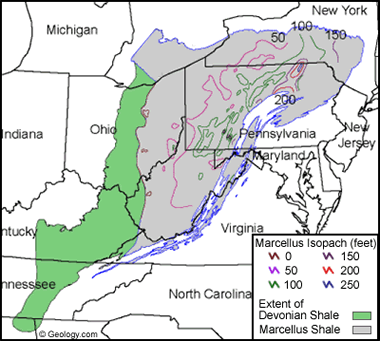
Given that the Marcellus Shale Play stretches over a number of states, the location of natural gas drilling provides an opportunity to explore the differences in political geography within this region. The case of New York versus Pennsylvania:

Talisman holds about 250,000 hectares on the New York side of the Marcellus and 100,000 hectares in Pennsylvania, the company's chief financial officer told a CIBC investor conference Friday.

"To date we've focused all of our efforts on Pennsylvania because it's been a much more receptive place to drill in. And New York had actually banned horizontal drilling," Scott Thomson said.

New York is working on a framework to regulate energy development in the state, and Talisman has participated in the consulting process.

"For 2010 we're not putting any capital towards New York," Thomson said.

I read the article as communicating that Pennsylvania is more environmentally lax than New York. The issue of water supply for populous areas is raised, but there are parts of New York State where that shouldn't be a primary concern (e.g. Southern Tier).

As long as the margin for drilling remains paper thin, New York looks to be at a competitive disadvantage. In financial terms, that's $1 billion invested in Pennsylvania and $0 in New York for 2010. In other words:

Talisman has made the development of shale gas a key plank of its strategy. In addition to the Marcellus, it has holdings in promising northeastern British Columbia shale plays.

The company is set to open up an office in Pittsburgh later this year, with activity in Pennsylvania set to ramp up significantly.

The rush is on.

Great Recession Geography

Unemployment is bad all over, but the following factoid surprised me:

[For the month of December,] South Carolina, Delaware, Florida, North Carolina and the District of Columbia were each at their highest jobless rates on record.

What's going on in those Sun Belt states?

Ruhr Valley Of The Rust Belt

Comparing Germany's Ruhr Valley to the Rust Belt is old hat. These two regions jump to the fore when we discuss industrial decline in Germany and the United States. However, the analogy is still instructive as we struggle to find a functional contiguous geography that might lend itself revitalization:

Germans often think of the region as a single entity, and taken together, it would in fact be the country's biggest city, with more than 5 million inhabitants. But the valley has less the feel of a city than a small, densely populated island: In some areas of the region, cities bleed into each other, while in other places there are wide stretches of agriculture that act as buffers between municipalities. Residents often have attachments to their local towns and develop rivalries against their neighbors. “When there's a soccer game between Dortmund and Bochum, you should probably stay off the local trains,” Willi Kaiser, a resident of Essen, said.

The homogeneity of the Rust Belt is a myth. Richard Longworth's struggles to delimit the Midwest for his book "Caught in the Middle" help to reveal the sub-regions of the US geography that globalization left behind. Plopping down the Ruhr Valley anywhere within Longworth's Midwest won't work. It fits best over the Metals axis of Cleveland and Pittsburgh.

Chris Briem has often compared Pittsburgh to Duisburg. But Americans don't think of "Cleveburgh" as a single entity. We should for the sake of economic redevelopment. The broad brush of the term "Rust Belt" belies the geographic diversity within the megaregion.

The Ruhr Valley is the TechBelt. I literally just noticed that the TechBelt website has been redone. It looks great! The history narrative could easily apply to the Ruhr Valley:

The TechBelt story over the past decade is one of profound economic reality on one hand and visionary leadership on the other. The region demonstrates a strong concentration of manufacturing employment that over the past few years has felt the continued transition of the U.S. economy. This transition has been painful to many of the communities throughout the region as anchor employers close their doors and jobs are lost.

There are still many however who view this transformation as an opportunity that through ingenuity and investment new opportunities are being created. For many years, this mega-region, has been working diligently to transition its economies toward more technology-based opportunities to ensure a bright future as it relates to job growth, per capita income and other measures.

Ohio and Pennsylvania governments have led the country with the creation of initiatives to support communities going through economic transformation. The Ohio Third Frontier initiative and Pennsylvania Ben Franklin Technology Development Authority have committed over $600 million to TBED activity in the region. These investments have created and continue to support programs, research, technology infrastructure and opportunities for the region to expand the strength and sheer number of technology based economic opportunities. The global economy is experiencing the most significant turbulence in a generation, which is likely to have profound impacts for regions throughout the U.S. The TechBelt region has survived this kind of turmoil in the past and now has the experience and the infrastructure to adapt to a changing economy. Regional leaders are optimistic that the investments that have been made, and the collaboration represented by TechBelt will enable the region to weather the storm and continue to transform. More must be done however to build on state and regional investments and attract federal and external capital to accelerate the pace of change.

The TechBelt Initiative unites the assets that have been created in the TechBelt communities and demonstrates the strength in numbers.

Perusing the committee members, I notice that the Power of 32 is conspicuously absent.

Thursday, January 21, 2010

Geographic Immobility

Why not stay where you are and invest in your hometown as it has invested in you? Let's stop the rural brain drain one educated person at a time. The benefits of stemming the tide are obvious. Educational attainment equals prosperity. In Northeast Ohio, that message is loud and clear:

Better education translates into better jobs, and ultimately, a better economy, added Barb Ewing, economic development director for U.S. Rep. Tim Ryan, D-17 Ohio.

“When companies look to locate or relocate, one of the first things they want to know is how high the level of educational attainment is in the community,” she said. “If we can’t provide that, then they’re not going to come here.”

The region will invest more resources into the education of its citizens. No child, even those on the wrong side of the tracks, will be left behind. Youngstown is a good example of the problem in terms of economic geography:

The researcher also noted that population has actually trended upward in the city -- rising from 60,000 according to the 2000 Census to about 65,000 in 2008, she said. At the same time, there has been a “continued decline” in the area’s suburban population in the later years of the decade, due possible to factors including out-migration of people with higher incomes. “So the number of poor just continues to go up as a percentage of the total population,” she said.

Tom Humphries, president and CEO of the Youngstown/Warren Regional Chamber, said the Brookings report really didn’t show anything that was surprising. “If we look at the economy and you read that article, you realize that you’re not alone,” he said.

The chamber has attempted to take a regional approach to issues such as education, a key element for attaining higher per capita incomes, over the past several years, Humphries said.

Better education results in higher per capita incomes. And higher incomes allow more people to flee the suburbs, yielding a greater concentration of poverty. It is an ironic outcome to a noble policy goal.

Getting high-flyers to stay put is a tall order. Working against any economic migration flow (e.g. Mexico-to-US) is usually an exercise in futility. The World Bank report I've been touting over the last few months recommends leveraging the trends instead of fighting them. The epiphany comes after decades of trying to plug the brain drain while bolstering educational attainment in the most impoverished countries.


"I think that, for at least a generation, parents have consigned themselves to the supposed inevitability that their children must leave the city for college and life," said Ms. Heidelbaugh, a lawyer. ...

... That doesn't just happen here. It happens everywhere. There is plenty of data that suggests we in Pittsburgh don't lose our young people to a degree greater than most places. We just don't attract the migrants, native and foreign, to replace our departing youth the way other metro areas do.

But it is the attitude and the expectation that Ms. Heidelbaugh says are different here. In her native St. Louis -- a city that has lost even more population than Pittsburgh, going from its 1950 peak of 857,000 to an estimated 371,000 today -- people don't resign themselves to the necessity of children leaving, she said.

In terms of out-migration, St. Louis isn't all that different from Pittsburgh. In many respects, the two cities are long lost cousins. Perhaps the attitude is different, but the results are similar. The problem is one of attraction, not retention. Some research published in 2003:

Policies designed to keep rural area college graduates "home" when they would be better off someplace else are clearly inefficient from society's point of view. However, strategies to attract experienced college-educated workers may not be. The current debate over brain drain overlooks the possibility that individuals' reasons for moving and their preferences for certain locations may change with age. Younger people move to take advantage of school and job opportunities. However, as people marry, have children, and acquire job experience, they may choose to relocate for "quality of life" reasons. There is little information about the motivations and choices of "reverse" migrants opting to relocate in mid-life. Policy makers should be concerned about the supply of all educated workers not just young educated workers.

I would welcome this kind of attitude adjustment. I would also hope that the afflicted communities would become more aware of what has been tried. Considering funding a bigger and better internship program to retain talent? Speak with representatives of the Scottish government first:

The business community is furious about the decision and careers officers at universities are outraged by the scrapping of Graduates for Business (GFB), which had a high success rate over the last decade helping graduates find a career, for a saving of just £1 million over three years. Some fear it could lead to a brain-drain of Scottish talent to England or abroad.

Scottish Enterprise (SE) mounted a strong defence of its decision on the basis that the internship scheme was not delivering the expected benefits in terms of turnover and job creation, and the Scottish Government said it was a decision for it.

There appears to be more to the story than SE is publicly stating. But to claim that GFB stemmed brain drain is disingenuous. This business community should be more forthcoming about why it is "furious". I doubt that we would find that a double or triple bottom line is in peril as some have claimed.

Trying to encourage young talent to stay is in no one's best interest.