Friday, October 23, 2015

The Geography of 'Displacement'

You keep using that word. I do not think it means what you think it means.

Theme: Migration and economic development

Subject Article: "An Antidote for the Unjust City: Planning to Stay."

Other Links: 1. "Economist Raj Chetty’s Proposals on Inequality Draw Interest on Both Sides of the Political Aisle."

Postscript: From "‘Migrants’ or ‘refugees’? It’s the wrong question. Here’s how to help the people fleeing to Europe.":

Focusing on whether to call the people entering Europe “migrants” or “refugees“ is itself part of the problem. It reinforces the idea that people on the move can be divided neatly into one of two categories: migrant or refugee. Human beings in the real world defy such simplistic categorization. They move for a wide range of reasons that fall somewhere between the extremes of purely voluntary and unquestionably forced.

Even to claim that migrants (or refugees) are "fleeing" is a simplistic categorization. The term "displacement" also deserves the same careful consideration.

Wednesday, October 21, 2015

When Generation Rent Becomes Generation Buy

Regions where Millennials are renting don't look like where they will buy homes.

Theme: Migration and housing

Subject Article: "Quick: Why I bought a house in Carbondale."

Other Links: 1. "Why the D.C. area risks losing its allure to millennials."

Postscript: Instead of fleeing the city for the suburbs, I think young adults looking to raise a family will leave the region in search of affordable single family homes in an urban environment.

Tuesday, October 06, 2015

What the Rust Belt Can Teach Us About White Flight, Gentrification, and Brain Drain

With a focus on why people leave, we ignore at least half of the migration story.

Theme: Ironic demographics

Subject Article: "Positive contact or 'white flight'?: why whites in diverse places are more tolerant of immigration"

Other Links: 1. "Brain Gain in America’s Shrinking Cities."
2. "Urban Decline in Rust-belt Cities."
3. "What White Population Growth in Detroit Means."
4. "The Legacy Cities Partnership."
5. "This Is Sprawl, Pittsburgh Edition."
6. "Census estimate shows Pittsburgh population decreasing."
7. "Gentrification and Residential Mobility in Philadelphia."
8. "A Self-Interested Approach to Migration Crises: Push Factors, Pull Factors, and Investing In Refugees."
9. "Does development reduce migration?"

Postscript: "Danes fleeing the big cities":

It’s mostly families with children who have made the move out of the urban areas in order to find a more affordable place to live, although they don’t tend to stray too far from the cities in order to maintain their jobs.

But despite the exodus, the capital and Aarhus are still growing, although that has more to do with immigration and an increase in births than urbanisation.

The supposed "urban age" is a lot of hype. Take immigrants out of the population equation and the United States has an epidemic of shrinking cities, including New York and Los Angeles. Americans are fleeing big cities, too.

Thursday, September 24, 2015

Migrant or Refugee?

The ontology of refugee is the problem, not the solution.

Theme: Geography of migration

Subject Article: "If she drowns she's a refugee, if she floats she's an economic migrant."

Other Links: 1. "Rethinking post-national citizenship: The relationship between state territory and international human rights law."

Postscript: For my doctoral dissertation (I didn't get beyond the exam stage), I intended to define geographic inquiry into the issue of human rights. My case study was the Reagan era interpretation of the Refugee Act, which paved the way for the spatial loophole known as Guantanamo. Migrants, domestic or international, experience less rights depending on where they are. Should what a newcomer to a neighborhood wants carry the same weight as what a tenured resident wants? Spike Lee's rant about gentrification is just as xenophobic as the anti-immigrant vitriol on display right now in Europe. All newcomers aren't welcome.

Monday, September 21, 2015

The Geographic Scale of Globalization Isn't Global

Nations—and even cities—don't globalize. Globalization spreads block by block.

Theme: Geography of globalization

Subject Article: "What cities tell us about the economy."

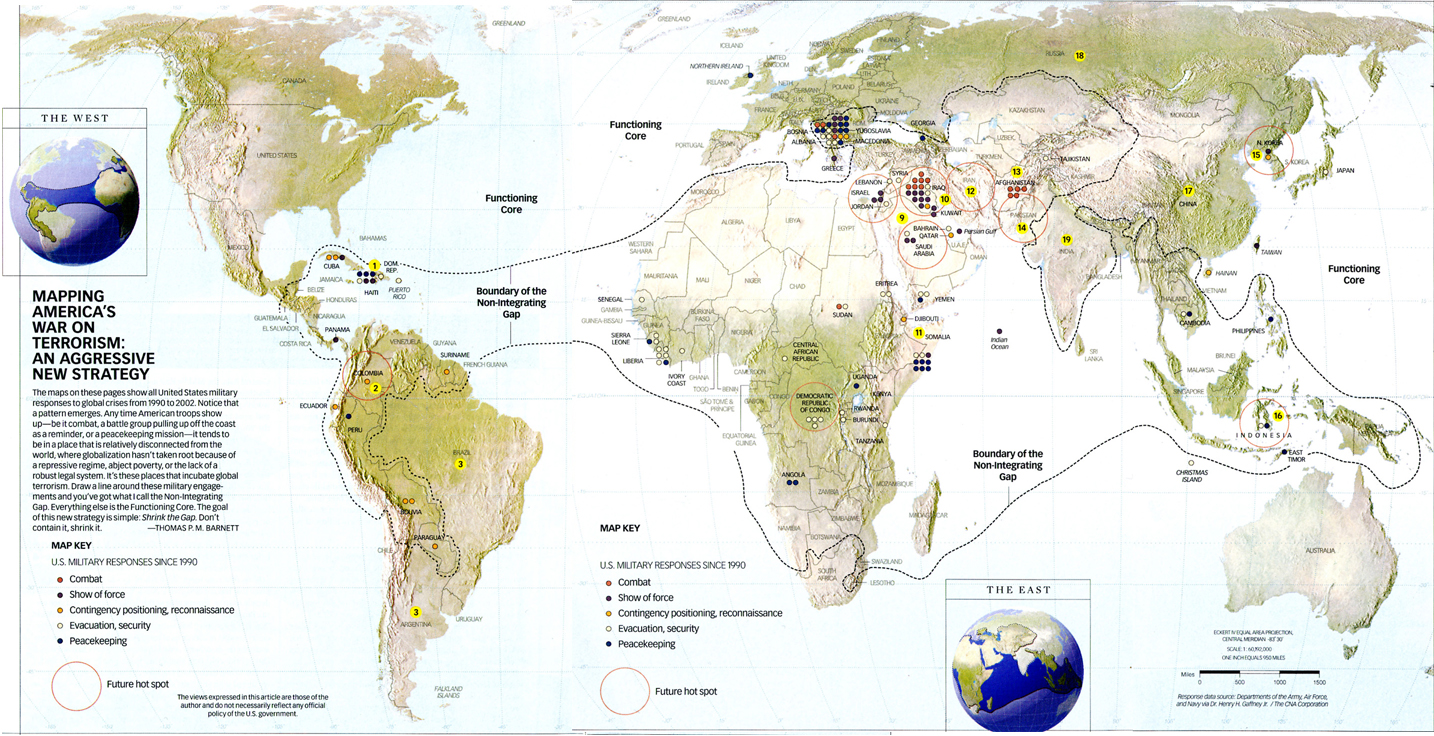
Other Links: 1. "Blast from my past: "The Pentagon's New Map" (2003)."
2. "Mapping America's War on Terrorism: An Aggressive New Strategy."
3. "Of cars and carts: Despite decades of reform, most Mexicans are still a long way from wealth and modernity."
4. "Get Canuckified at Moe's."
5. "Space and Place: The Perspective of Experience."
6. "A Long History of a Short Block: Four Centuries of Development Surprises on a Single Stretch of a New York City Street."
7. "From Metal to Minds: Economic Restructuring in the Rust Belt."
8. "Urban Decline in Rust-belt Cities."

Postscript: Demographer John Weeks also looked at the Economist article about economic development in Mexico:

But the birth rate is not evenly low throughout Mexico, even though it is lower in every state now than it used to be. I created a state-by-state map of the TFR in Mexico for 2000 from the INEGI data, and you can see that fertility is very low in Mexico City and especially in states closer to the US-Mexico border. I used data for 2000 instead of 2013 for the map because these data will reflect the youth population of today--the group of people needing to be absorbed by the Mexican economy. The state of Guerrero, just to the south of Mexico City (albeit over the mountains), and the state of Coahuila, bordering south Texas, had the highest fertility levels in 2000 (as they do still now). So, proximity to the engines of modernization (i.e., Mexico City and the US) does not ensure low fertility. At the same time, the lowest levels of fertility are generally found in Mexico City and its surrounding areas, and along the rest of the US-Mexico except for Coahuila. But you can also see that fertility is below average in the Yucatan peninsula. As the Economist rightly notes, it is the combination of geography and culture that matters, and that is the essence of spatial demography.

Fair to say, Weeks comes to a different conclusion than I do. I make a big deal about proximity to the engines of modernization. Weeks downplays the effects. The two perspective aren't mutually exclusive. Instead, the tension raises a host of interesting research questions.

Wednesday, September 16, 2015

Debunking Texas Exceptionalism: De-Regulation Will Not Save Us

Houston has a de facto zoning problem.

Theme: Geographic stereotypes

Subject Article: "Forget What You’ve Heard, Houston Really Does Have Zoning (Sort Of)."

Other Links: 1. "No Old Maps Actually Say 'Here Be Dragons'."
2. "Houston, New York Has a Problem: The southern city welcomes the middle class; heavily regulated and expensive Gotham drives it away."
3. "Debunking Texas Exceptionalism."
4. "The Shapes of Cities."

Postscript: Unfortunately, ideological thinking drives a lot of academic inquiry. Density is good. Sprawl is bad. Deregulation is good. Big government is bad. The facts are made to fit an a priori conclusion. The author over-interprets the data. I'm most sensitive to the use of normative geographies. Houston's lack of zoning doesn't make the city exceptional. What makes the metro so active to the middle class? Sprawl. Density bad. Sprawl good. See what I mean?

Tuesday, September 01, 2015

The Second Machine Age Is Dying

Get ready for an unprecedented economic boom in the United States.

Theme: Geography of economic convergence

Subject Article: "How New Orleans Built a Bustling Tech Hub in Katrina's Wake."

Postscript: In both the first and second machine age, the economy is geographically divergent and then geographically convergent. The iconic place of divergent first machine age was Pittsburgh with its dominance of steel production:

The 40-year period from 1870 until 1910 marked Pittsburgh’s Golden Age. Favorable geography, unique natural resources and a super-abundance of entrepreneurial talent lifted Pittsburgh to a position of national and international prominence never seen before or since.  Pittsburgh’s growth is a story of heavy industry, specifically steel. Population statistics speak to Pittsburgh’s dynamism during this period. The city’s population grew sixfold in those 40 years, from 86,076 to 533,905. Allegheny County nearly quadrupled, to 1,018,463 residents. The local population growth rate doubled that of the nation. In 1900 the value of manufactured products in Pittsburgh was more than Cleveland and Detroit combined.

1910 was peak Pittsburgh. 1910 was peak divergent first machine age in the United States. After that, the region experienced a long slide that lasted about a century. In terms of manufacturing (the dominant industry of the first machine age), that slide continues in terms of labor market share.

The iconic place of convergent first machine age was Detroit:

For almost a half century last century, Detroit was a boom town. Between 1910 and 1950, few cities grew faster, were wealthier, were more attractive to those seeking success than what became known as the Motor City.

1950 was peak Detroit. 1950 was peak convergent first machine age in the United States. After that, the region experienced a long slide that well could last a century. The automobile isn't coming back, at least in terms of employment.

For almost a half century last century, Silicon Valley was a boom town. The 40-year period from 1950 until 1990 marked Silicon Valley's Golden Age. It was the iconic place of divergent second machine age.

That means we are about 25 years into convergent second machine age. Seattle? Boston? Someplace else? I'm trying to locate the iconic place of the convergent cycle of the second machine age.

Wednesday, August 12, 2015

Ezra Klein Is Transforming Education

Journalists have replaced teachers as the curators of expertise.

Theme: Workforce development and talent

Subject Article: "Ezra Klein Finds Conversations About the Future of Journalism 'Tiresome.'"

Other Links: 1. "Labor Disputes, Wooden Shoes, and Italian Bread."

Postscript: Concerning economic development, I focus on education and health care. The interview with Ezra Klein says a lot more about the future of education than it does journalism. Readers consume content and learn. Klein's business model subsidizes that education. Klein's business model cares more about the quality of the audience than quantity of audience. This is a matter of education, not journalism.

Friday, July 31, 2015

Why Top Talent Must Flee Silicon Valley

In order for tech workers to cash out on home equity, Proposition 13 forces them to move to another state.

Theme: Real estate refugees

Subject Article: "Silicon Valley is Going to Retrench in 2016."

Other Links: 1. "Are High Housing Costs Forcing Talent to Flee Silicon Valley?"
2. "The Lock-in Effect of California's Proposition 13."
3. "Tesla says Nevada battery plant on track despite report of delay."

Postscript: Expensive Bay Area real estate does much more to deter talent from moving there than it does to push it out. In fact, the tech industry might have converged faster nationally if Proposition 13 didn't discourage relocation. Supply isn't distorted as much as demand is. As out of state tech markets become more attractive to talent, the Prop 13 effect will flip from an agent of retention to one of exodus.

Thursday, July 23, 2015

Exploiting Puerto Rico's Fuzzy Sovereignty

With the homeland as neither nation nor state, Puerto Ricans twist in the wind of political whimsy.

Theme: Human rights geography

Subject Article: "The problem with Puerto Rico's debt."

Other Links: 1. "Murder at Sea: Captured on Video, but Killers Go Free."
2. "American Experience: The Pill."
3. "The Insular Cases: Constitutional experts assess the status of territories acquired in the Spanish–American War."

Postscript: "Reconsidering the Insular Cases: The Past and Future of the American Empire."

Over a century has passed since the United States Supreme Court decided a series of cases, known as the “Insular Cases,” that limited the applicability of constitutional rights in Puerto Rico and other overseas territories and allowed the United States to hold them indefinitely as subordinated possessions without the promise of representation or statehood. Essays in this volume, which originated in a Harvard Law School conference, reconsider the Insular Cases. Leading legal authorities examine the history and legacy of the cases, which are tinged with outdated notions of race and empire, and explore possible solutions for the dilemmas they created. Reconsidering the Insular Cases is particularly timely in light of the latest referendum in Puerto Rico expressing widespread dissatisfaction with its current form of governance, and litigation by American Samoans challenging their unequal citizenship status. This book gives voice to a neglected aspect of U.S. history and constitutional law and provides a rich context for rethinking notions of sovereignty, citizenship, race, and place, as well as the roles of law and politics in shaping them.

Thinking about the Insular Cases in a generic sense, citizenship in any space at any scale is not a binary. In terms of territory or turf, citizenship is experience on a continuum. In a neighborhood, newcomers do not enjoy the full benefits of citizenship that the most tenured residents enjoy. Newcomers are expected to conform and labor to fit in, prove they belong. For example, Spike Lee's rant about the gentrification of Brooklyn:

Then comes the motherfuckin’ Christopher Columbus Syndrome. You can’t discover this! We been here. You just can’t come and bogart. There were brothers playing motherfuckin’ African drums in Mount Morris Park for 40 years and now they can’t do it anymore because the new inhabitants said the drums are loud. My father’s a great jazz musician. He bought a house in nineteen-motherfuckin’-sixty-eight, and the motherfuckin’ people moved in last year and called the cops on my father. He’s not — he doesn’t even play electric bass! It’s acoustic! We bought the motherfuckin’ house in nineteen-sixty-motherfuckin’-eight and now you call the cops? In 2013? Get the fuck outta here!

Nah. You can’t do that. You can’t just come in the neighborhood and start bogarting and say, like you’re motherfuckin’ Columbus and kill off the Native Americans. Or what they do in Brazil, what they did to the indigenous people. You have to come with respect. There’s a code. There’s people.

In this passage, Spike Lee is anti-newcomer. He isn't anti-gentrification. He invokes tenure as the measure for the right to define cultural space. Hey Spike Lee, get the fuck outta here with your xenophobic bullshit.

Wednesday, July 22, 2015

Atlanta's Talent Attraction Problem

From 2000–2013, Atlanta has fallen further behind other large metros in growing its population of college-educated young adults.

Theme: Higher education and economic development

Subject Article: "Best and Worst Cities for Educating Blacks: Instead of educating their own, some cities are importing college graduates."

Other Links: 1. "The Talent Migration Paradox."
2. "Debunking Texas Exceptionalism."
3. "Globalization and Atlanta's Gated Urban Core."
4. "Trolling for millennials with the Atlanta Streetcar."

Postscript: "We're now at a point in Georgia where you can't sustain those high attainment rates just by importing more people," says McGuire. "The challenges in Georgia, and in metro Atlanta for sure, have a lot more to do with doing a better job with the kids who are here than simply counting on lots of middle class families to move here and solve the demands of employers that way."

Friday, July 17, 2015

How Can Rust Belt Cities Attract More Immigrants?

Communities might roll out the red carpet for the foreign-born, but the more welcoming disposition doesn't do the trick.

Theme: Immigration and economic development

Subject Article: "Why newcomers are beginning to bypass Canada’s big cities."

Other Links: 1. "WE Global – Leading Rust Belt Immigrant Innovation."
2. "Population And Prosperity."
3. "Reading, Pa., Knew It Was Poor. Now It Knows Just How Poor."
4. "'The Handmaid's Tale' Is Economic Development."
5. "UNH study: Mexican migration plummets — as immigrant income rises."

Postscript: As the era of rural-to-urban international migration comes to an end, immigration to the United States will matter more in terms of quality than quantity. Immigrants won't boost the population. They will boost the regional economy.

Wednesday, July 15, 2015

Re-Location Is an Entrepreneurial Act

Correction: A reader of the post at Pacific Standard sent to me an email message pointing out an error I made. I reversed the characteristics of System 1 and System 2 thinking. System 1 is "fast" and System 2 is "slow".

Out of necessity, old habits die easily for migrants.

Theme: Innovation and migration

Subject Article: "Easing the Pain of Relocation."

Other Links: 1. "The Economic Case for Welcoming Immigrant Entrepreneurs."
2. "German Pork Butchers in Britain."
3. "Voting With Your Feet."
4. "The White Flight Myth."

Postscript: The psychology of migrants and the geography of migration are closely linked. While most migration appears to be economically rational, the precise location decisions are irrational. I live in Northern Virginia, a tight real estate market. I take advantage of the irrational location decision of well-educated mothers, who are willing to pay a large premium to reside in the neighborhoods associated with the "best" schools. I get more house in a better location thanks to the perception of school quality, which I know from graduate level data analysis courses in the social science to be off the mark in terms of outcomes. The movement between regions looks (and is) rational. But dig deeper into the destination region and stereotypes trump careful analysis.

Sunday, July 12, 2015

Economic Growth in an Era of Demographic Decline

A shrinking population isn't the end of economic expansion.

Theme: Ironic economic indicators

Subject Article: "Obamacare’s Big Gamble on Hospital Productivity."

Other Links: 1. "Japan’s population slide set to accelerate."
2. "The Depopulation Bomb."
3. "Advanced industries drive down prices, making income more valuable."
4. "Era of Dying Places."

Postscript: Economist Tyler Cowen musing about China's demographic decline problem:

The Chinese employment rate has been increasing steadily, as has Chinese productivity.  In other words, improvements in both labor quantity and labor quality can help offset the aging problem.

Worth noting that Cowen isn't as optimistic about the same demographic pressures welling up in already wealthy countries. I disagree. But that's a larger debate for another time.

Monday, June 29, 2015

The Political Geography of Market Urbanism

The later the economic boom, the greater the municipal area.

Theme: Demography and economic development

Subject Article: "Pittsburgh’s population challenges stand out."

Other Links: 1. "Jurrassic Park Houston, defending Texas exceptionalism, passing Chicago, Market Urbanism, and more."
2. "How soon will Houston pass Chicago? The question isn't whether we'll be the nation's third-largest city. It's when."
3. "Debunking Texas Exceptionalism."

Postscript: Real estate market economist Jed Kolko responded to my criticism of conflating population change with domestic migration by pointing out that population change strongly correlated (positively) with domestic migration. There I sat with a straw man argument on my lap. Or so it seemed. Data in aggregate often obscure more than they illuminate. For example, one of the largest domestic migration flows in the entire country is from Texas to California. That's a gaping hole in the assertion that restrictive zoning on building repels migrants. Demographics aside, greenfield development is a different animal from infill. Greenfields are cheaper and politically less encumbered. Economically, the Sun Belt is playing catch up with the Rust Belt (much like developing countries are chasing developed countries). This game of convergence is far from fulfilled. In fact, in recent decades, the wealthiest Rust Belt states have started pulling away again from the Sun Belt. So Sun Belt cheerleaders continue to hang their hats on population growth without fulling understanding the demographics. The Sun Belt is not exceptional. Most of it remains well behind the rest of the country.

Thursday, June 25, 2015

Debunking Texas Exceptionalism

Winning the demographic lottery is nothing to crow about.

Theme: Ironic demography

Subject Article: "How soon will Houston pass Chicago?"

Other Links: 1. "Low Taxes And Economic Opportunity In Texas Lead To Youth Population Boom."
2. "An Urban Agenda for the Right."
3. "Shrinking City Chicago."
4. "The Texas Migration Miracle."
5. "Gentrification."
6. "Keeping a Strong Texas Economy."

Postscript: Out of one side of my mouth, I lampoon Texas Exceptionalism. Out of the other, I celebrate Houston's demographic exceptionalism:

“After 1982, the Anglo population of Harris County stopped growing,” said Klineberg. “And all the growth, of the most rapidly growing city in America, has been from the influx of African Americans, Latinos and Asians. And this biracial southern city dominated by white men has become, in the last 30 years, the single most ethnically diverse major metropolitan area in the entire country.”

Houston is special because of immigration, not domestic migration. State and urban policies do little to influence international migration. The touting of pro-business legislation and overall deregulation as the reason for the population boom is at least 75% nonsense (i.e. the part of population growth attributed to natural increase and immigration). As for zoning, or lack thereof, it takes a backseat to greenfield sprawl in terms of keeping housing costs affordable. The Sun Belt is nothing more than Rust Belt sprawl.

Tuesday, June 23, 2015

The Talent Migration Paradox

Better to develop people and have them leave than to attract and retain college graduates.

Theme: Migration and economic development

Subject Article: "Fastest-Growing U.S. Cities Import Their College Graduates."

Other Links: 1. "Joe Cortright Talent Dividend Metrics."
2. "Beyond the Creative Class."
3. "Talent Attraction Expert Joe Cortright."

Postscript: For the migrants themselves, attracting talent is economic development. For the destination community, migration is not economic development. The tale of two cities in terms of inequality concerns townies and outsiders. Tenured residents are left behind or pushed out of place.

Tuesday, June 16, 2015

The Geography of Aspiration

Migration analysis places too much emphasis on push factors and not enough on the pull of opportunity.

Theme: Models of migration

Subject Article: "The low skilled are less mobile geographically because of the meagre value of work."

Other Links: 1. "Income per Natural: Measuring Development as if People Mattered More Than Places."
2. "A Sharp Drop in Interstate Migration? Not really: New data procedures led to misperception of dramatic decline in U.S. population mobility."
3. "This Government Program is Reducing American Mobility. Here’s Why That’s Hurting Our Economy."
4. "Benefits of Bowling Alone."
5. "Why are Higher Skilled Workers More Mobile Geographically? The Role of the Job Surplus."

Postscript: Fueled by macroeconomic cycles, who migrates and why change over time. Manufacturing jobs didn't offer a skill premium, begetting the Great Migration. Sometime after WWII, probably in the late 60s or early 70s (oil crisis of 1973 as a big break), the script flipped. The better educated had more reason to move. Couple that with a low-skilled international migration that mirrored the Great Migration and kept employers happy with a cheap supply of labor. Fast forward to today, companies in the market for low-skill or middle-skill workers will have a tough time filling positions.